


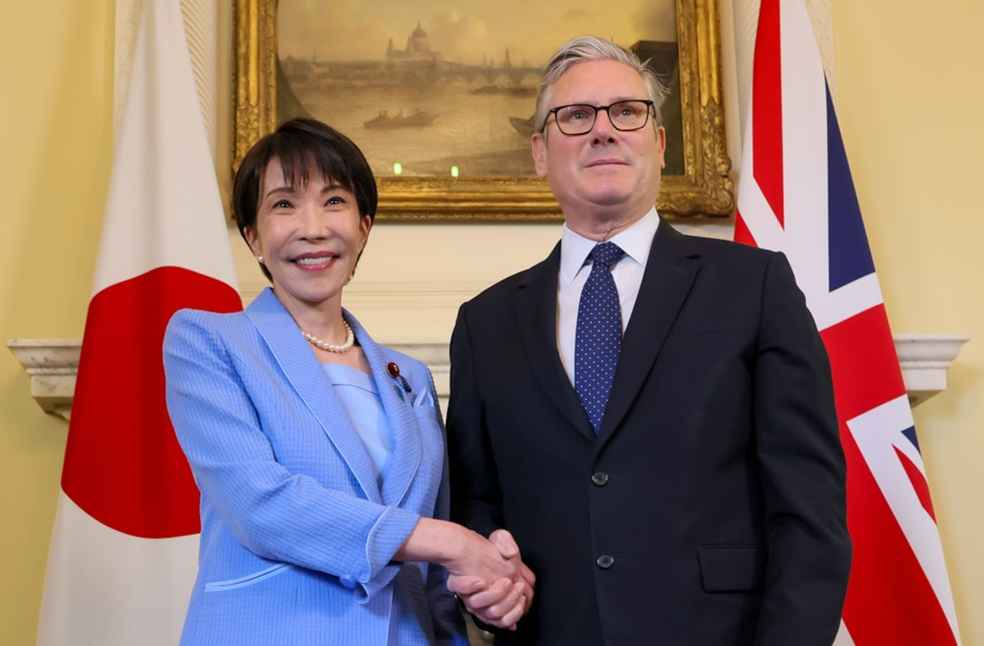
The United Kingdom and Japan on Sunday announced a $24 billion (£18 billion) investment agreement during Japanese Prime Minister Sanae Takaichi’s visit to London.
UK Prime Minister Sir Keir Starmer and Sanae Takaichi confirmed a series of agreements had been reached under which Japanese companies will invest up to £18 billion in the United Kingdom, focusing on the infrastructure, financial services, and renewable energy sectors.
British Prime Minister Keir Starmer and Japanese Prime Minister Sanae Takaichi held discussions at Downing Street ahead of the G7 summit in France, which is set to begin on Monday. During their discussions, more than 10 trade agreements were signed, including a £9 billion offshore wind project.
Starmer described the agreements as marking “a new era of cooperation between our two countries.”

Under the terms of the agreements, Japanese companies will invest approximately £9 billion in UK infrastructure and financial services, and an additional £9 billion in offshore wind projects. According to the Prime Minister’s Office, these investments are expected to generate tens of thousands of jobs. One of the agreements would also see cooperation between Rolls-Royce and Japan’s Atomic Energy Agency.
The two governments further announced the launch of the UK-Japan Frontier Tech Partnership (FTP), aimed at converting British research into scalable technologies with Japanese investment in fields such as AI and semiconductors. As part of this initiative, a production agreement will connect the British Semiconductor Center with Rapidus, Japan’s newly established chipmaker.
On the defense front, both leaders reaffirmed their commitment to the Global Combat Air Program (GCAP), a joint initiative to develop a next-generation supersonic fighter jet. Starmer emphasized the project as central to the bilateral relationship.

Launched in 2022 by the UK, Italy, and Japan, the program aims to deliver a replacement for the Eurofighter Typhoon by 2035.
Meanwhile, total trade between the UK and Japan currently stands at around £140 billion, according to the UK government.
The deal comes against the backdrop of Britain’s economic challenges. While the UK economy grew by 0.6 percent in the January–March quarter—the fastest among G7 nations—the International Monetary Fund has cautioned that ongoing conflict in West Asia could disproportionately impact the UK compared to other advanced economies.
POLICY & LAW | UK to Ban Russian Diesel and Jet Fuel Imports by 2027

