


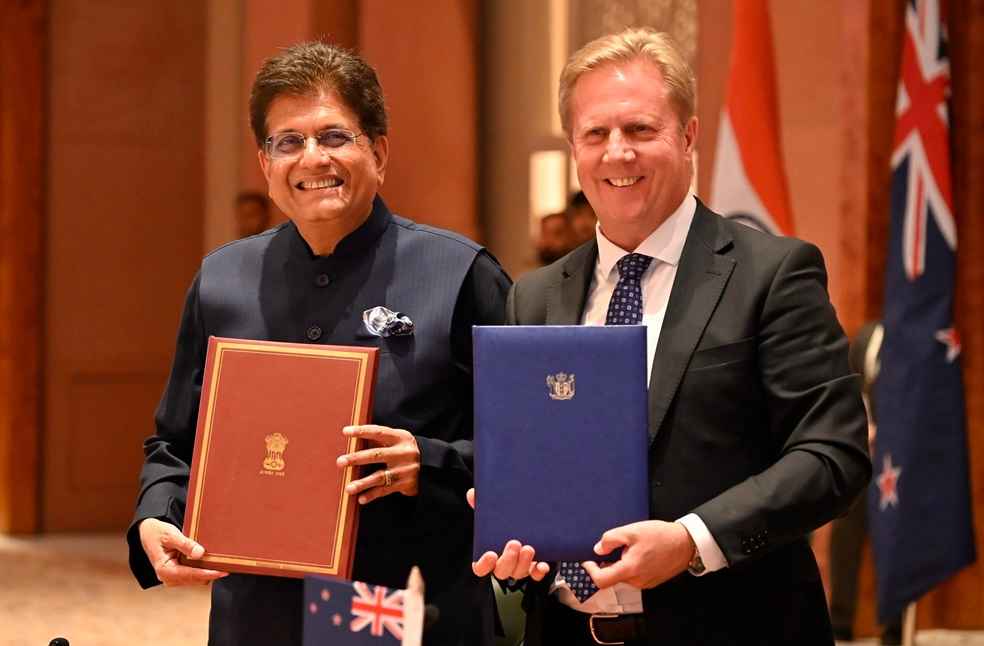
India and New Zealand on Monday signed a free trade agreement, securing full tariff removal on all Indian exports and cutting duties on 95% of New Zealand’s shipments to India. Under the deal, Wellington has also committed to investing $20 billion in India over the next 15 years.
The agreement is expected to be implemented by the end of the year, as it still requires approval from the New Zealand Parliament.
This marks the second time India has secured a foreign direct investment (FDI) commitment of $20 billion over 15 years in a trade deal. A similar pledge of $100 billion was made by the four-nation European Free Trade Association (EFTA) in its agreement with India.
The India–New Zealand pact, signed by India’s Commerce and Industry Minister Piyush Goyal and New Zealand’s visiting Trade and Investment Minister Todd McClay, is expected to double bilateral trade in goods and services to $5 billion within five years.
India and New Zealand had concluded negotiations in December last year, when India was grappling with steep U.S. tariffs.
“The investment commitment of $20 billion by New Zealand will further strengthen our cooperation in agriculture, manufacturing, innovation, and technology, paving the way for a more prosperous and dynamic future for both countries,” Indian Prime Minister Narendra Modi said on X.

New Zealand Prime Minister Christopher Luxon described the deal as a ‘once-in-a-generation agreement,’ saying it would give exporters exceptional access to 1.4 billion people and to an economy projected to become the world’s third largest.
“At the heart of the agreement is the empowerment for exports, agricultural productivity, student mobility, skills, investment, and services,” Goyal said.
The agreement grants India full duty-free access to the New Zealand market across 100% of tariff lines, including key export sectors such as textiles, apparel, leather, footwear, gems and jewellery, engineering goods, and processed foods. Previously, New Zealand imposed peak tariffs of up to 10% on major Indian exports like ceramics, carpets, automobiles, and auto components.
In return, India has agreed to reduce tariffs on 70% of tariff lines from New Zealand, covering 95% of the total bilateral trade value, while excluding 29.97% of product categories from the agreement.
The agreement excludes several sensitive products, including dairy items such as milk, cream, cheese, and yoghurt; certain animal products; key agricultural goods like onions, chana, peas, corn, and almonds; sugar and related products; fats and oils; arms and ammunition; gems and jewellery; and metals such as copper and aluminium, along with their derivatives.
India will grant duty-free access to selected New Zealand exports, including wood logs, coking coal, metal scrap, wood, sheep meat, and leather raw hides.
Tariffs on items such as petroleum oils, malt extract, vegetable oils, certain machinery, and peptones will be reduced gradually over 3 to 10 years. New Zealand exports like wine, pharmaceuticals, polymers, aluminium, and iron and steel products will also benefit from tariff reductions.
For products such as Manuka honey, apples, kiwifruit, and milk albumin, India has introduced quota-based concessions along with safeguards like minimum import prices to protect domestic producers while ensuring quality imports. Tariff rate quotas for apples, kiwifruit, and Manuka honey will be overseen through agriculture productivity action plans monitored by a joint council.
On the services front, New Zealand has offered India market access in around 118 sectors, including IT, telecom, finance, education, and tourism, boosting India’s service exports.
Additionally, New Zealand will extend Most-Favoured Nation (MFN) status in about 139 sub-sectors.
The FTA also introduces a temporary work visa route for Indian professionals in skilled roles, allowing up to 5,000 visas at a time with stays of up to three years. It also establishes, for the first time, a dedicated framework for student mobility and post-study work opportunities between India and New Zealand.
In 2024, total bilateral trade in goods and services between India and New Zealand reached $2.4 billion. Merchandise trade accounted for $1.3 billion in 2024–25, comprising $711.1 million in exports and $587.13 million in imports. Services trade alone contributed $1.24 billion, driven primarily by travel, IT, and business services.
India’s key exports included aviation fuel, pharmaceuticals, motor vehicles, petroleum products, garments, and machinery. Imports from New Zealand consisted mainly of wood and wood products, iron and steel, raw wool, dairy items, scrap metals, coal, and agricultural inputs.
TRADE WORLD | Malaysia and EU Near Free Trade Agreement to Boost Ties