


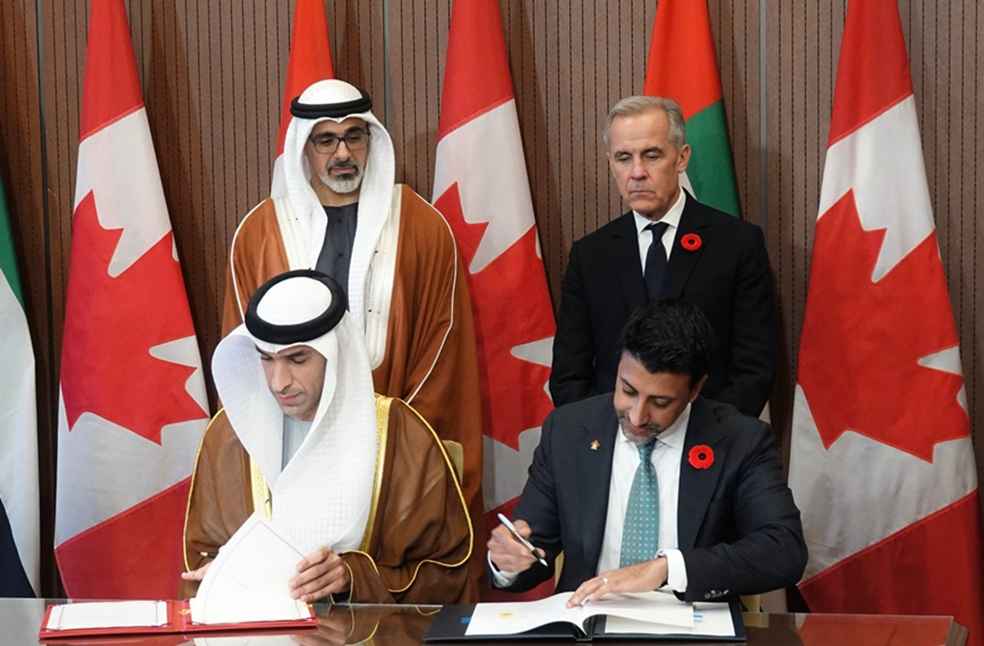
Canada signed a trade agreement with the UAE on Tuesday to expand market access for Canadian exports as Ottawa seeks to diversify its trade partnerships beyond the United States.
According to the Canadian prime minister’s office, the Comprehensive Economic Partnership Agreement (CEPA) will eliminate or reduce tariffs on more than 99% of current Canadian exports to the UAE once fully implemented. The agreement is expected to enter into force in 2027.
The agreement is expected to improve market access for Canadian pulses, canola, industrial machinery, power generation equipment and aerospace products. It also seeks to reduce non-tariff barriers and broaden market access for goods and services across sectors such as forestry, seafood and engineering.

PM Mark Carney has pledged to double exports to markets outside the United States over the next decade. U.S. President Donald Trump’s tariffs and the collapse of trade negotiations with Washington have led Ottawa to pursue new trade agreements across Asia, Europe and the Middle East.
Canadian International Trade Minister Maninder Sidhu and UAE Foreign Trade Minister Thani Al Zeyoudi signed the agreement in Ottawa at a ceremony attended by Carney and Abu Dhabi Crown Prince Sheikh Khaled bin Mohamed bin Zayed Al Nahyan.
“We see considerable potential for our private sector,” Al Zeyoudi said, pointing to potential exports and investment across logistics, communications, advanced technology and manufacturing.
The UAE is Canada’s largest export destination in the Middle East. According to Canadian government data, bilateral merchandise trade reached C$3.5 billion ($2.48 billion) in 2025.
The two countries also signed preliminary agreements covering energy, diplomatic relations and defense cooperation. Last year, the UAE pledged to invest up to $50 billion in Canada.
TEXTILE & APPAREL | India’s Textile Industry Targets $350B by 2030 Amid Export Recovery