


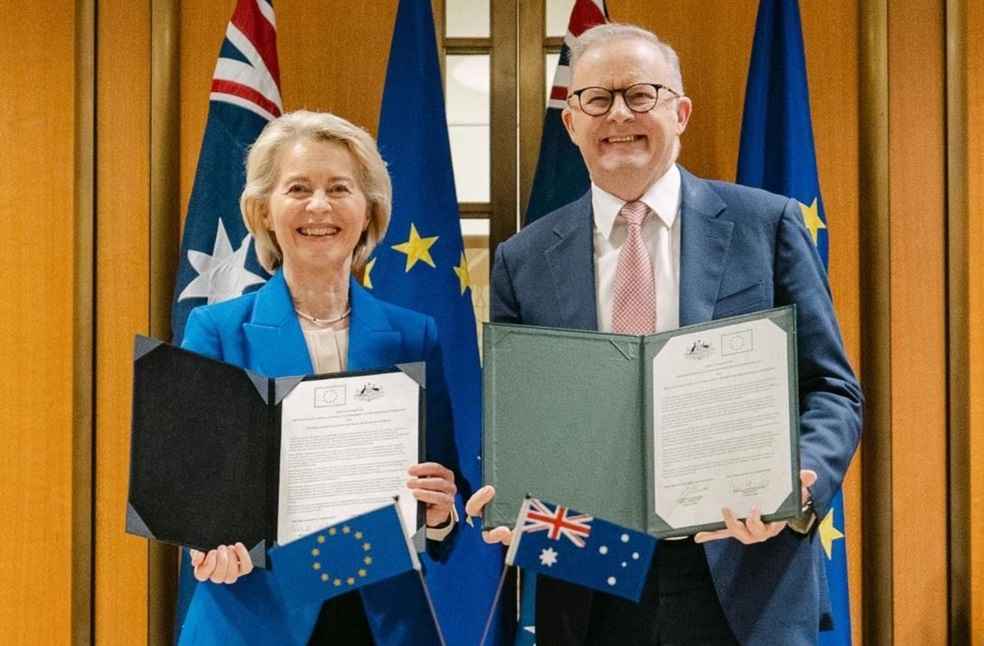
The European Union and Australia reached an agreement on the final text of a free trade agreement on Tuesday, approximately two years after negotiations had stalled over Australian demands. European Commission President Ursula von der Leyen and Australian Prime Minister Anthony Albanese concluded the long-anticipated deal, aiming to strengthen export opportunities amid ongoing global trade uncertainty.
The agreement, concluded after nearly eight years of negotiations, will eliminate most tariffs previously imposed by the two sides and grant the European Union broader access to Australia’s critical mineral resources. The breakthrough comes as both the EU and Australia seek to diversify trade partnerships, reduce dependence on China, and limit exposure to unpredictable U.S. tariffs.
Ursula von der Leyen emphasized that the agreement reflects a closer alignment between the EU and Australia, noting that the two are “moving even closer together.”

The deal signed in Canberra, valued at approximately A$10 billion, was hailed by Australian Prime Minister Anthony Albanese as a mutual ‘win‑win.’ Under the agreement, the European Union will abolish about 98% of duties on Australian exports; in return, Australia will lift more than 99% of tariffs on EU goods, notably dairy, motor vehicles, and chemicals.
The volume of Australian beef permitted into the EU is also expected to rise more than tenfold over the next decade. The agreement will lead to the removal of nearly all EU tariffs on Australian agricultural goods, including wine, fresh produce, olive oil, seafood, most dairy products, and grains such as wheat and barley.
The Australian government estimates that local wine producers and exporters will save around A$37 million as a result of the deal. For consumers in Australia, the agreement is expected to lower the cost of European imports such as wine, spirits, biscuits, chocolates, and pasta.
The deal also allows Italian-style sparkling wine produced in Australia to continue being sold domestically under the name Prosecco, although this name will be gradually phased out for exports over a period of 10 years. Food naming rights remain a sensitive issue in both regions, and Australia now stands as the only country outside Italy that has secured EU approval to use the name Prosecco.
The EU primarily imports mineral and agricultural products from Australia while exporting machinery, appliances, transport equipment, and chemicals to the Asia-Pacific nation. The agreement also establishes a bilateral safeguard mechanism, enabling the EU to implement protective measures for sensitive domestic industries if a surge in Australian imports negatively impacts its market.
In addition, the bloc will secure supplies of critical raw materials—including aluminum, lithium, and manganese—considered essential to its economic security. This move aligns with the EU’s broader strategy to reduce reliance on China, particularly in the critical minerals sector, where Beijing has imposed export restrictions.
On the other hand, Australia will eliminate a 5% tariff on European imports, benefiting industries such as automotive manufacturers, including BMW and Mercedes, as well as producers of fashion goods, food, and beverages.
On the security front, both sides have agreed to deepen cooperation in crisis management, maritime security, and emerging technologies such as artificial intelligence. The agreement also expands military collaboration, covering areas like cybersecurity and counter‑terrorism, while strengthening joint research initiatives.
TEXTILE & APPAREL | India Weighs Anti‑Dumping Duties on Chinese Viscose Yarn Imports