


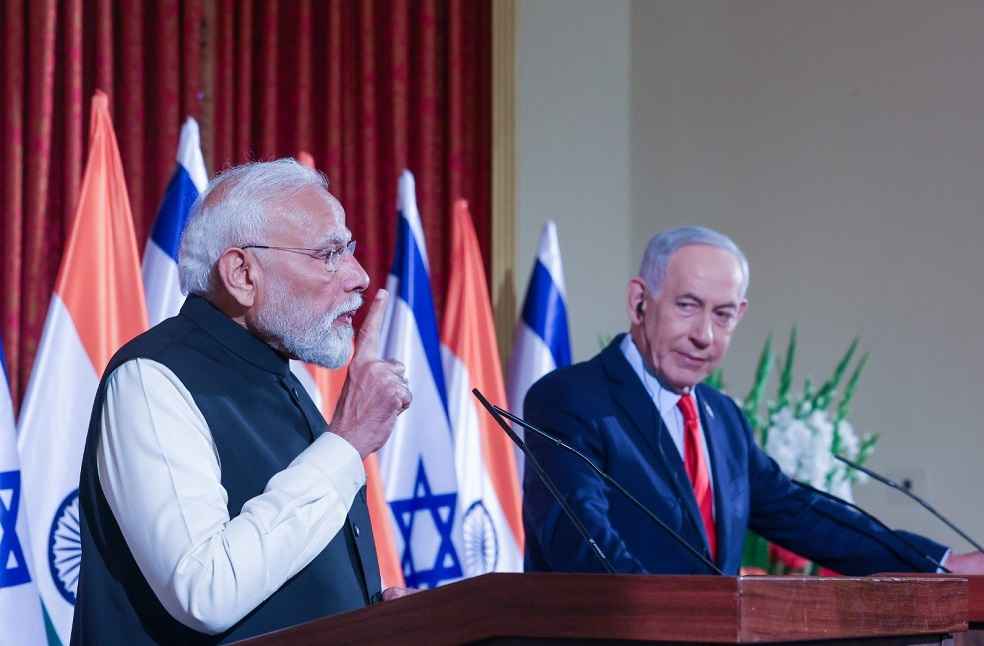
India and Israel have agreed to deepen cooperation in defence technology and pursue a free trade agreement, as Prime Minister Narendra Modi concluded a two-day visit to Jerusalem that drew political attention at home.
Speaking alongside Israeli Prime Minister Benjamin Netanyahu at a joint press conference, Modi said the two countries would expand collaboration in defence innovation and strengthen economic ties. Netanyahu described the partnership as rooted in shared civilizational heritage and driven by a joint commitment to technological advancement.
“The future belongs to those who innovate, and Israel and India are bent on innovation,” Netanyahu said, adding that both nations were determined to shape emerging sectors together.
The leaders confirmed the signing of more than a dozen bilateral agreements covering defence, trade, and advanced technologies, including artificial intelligence and cybersecurity. A joint statement also highlighted cooperation in ‘horizon scanning,’ a data-driven mechanism aimed at identifying emerging global trends across technology, economic development, and society.
In addition, Israel agreed to permit 50,000 more Indian nationals to work in the country. The move comes as Israel has relied increasingly on foreign labor, including workers from South Asia, to fill construction and caregiving roles following new restrictions on Palestinian workers imposed after the outbreak of the war in Gaza.
Modi’s visit marked his second trip to Israel since taking office in 2014 and reflects a steady strengthening of bilateral ties. The visit has, however, faced criticism in India, with opponents pointing to the humanitarian toll of Israel’s ongoing war in Gaza, which has reportedly resulted in more than 72,000 deaths.

The joint statement referenced the Hamas-led attack on Israel on October 7, 2023, as well as an April 2025 attack on tourists and civilians in Pahalgam in Indian controlled Kashmir. Both leaders condemned terrorism in all forms.
“Terrorism cannot be accepted in any form or expression,” Modi said. While India has historically supported the establishment of a Palestinian state, it has in recent years moderated its criticism of Israel in multilateral forums, including at the United Nations.
Earlier this month, India joined other countries in condemning Israeli measures seen as deepening control over the occupied West Bank.
Both governments also expressed support for efforts led by United States President Donald Trump to advance a ceasefire in Gaza.
The latest agreements underscore a growing strategic alignment between New Delhi and Tel Aviv, combining defence cooperation, economic integration, and emerging technology partnerships at a time of shifting regional and global dynamics.
TRADE TECH | China Hikes Optical Fiber Prices as Russia Relies Heavily on Imports
