


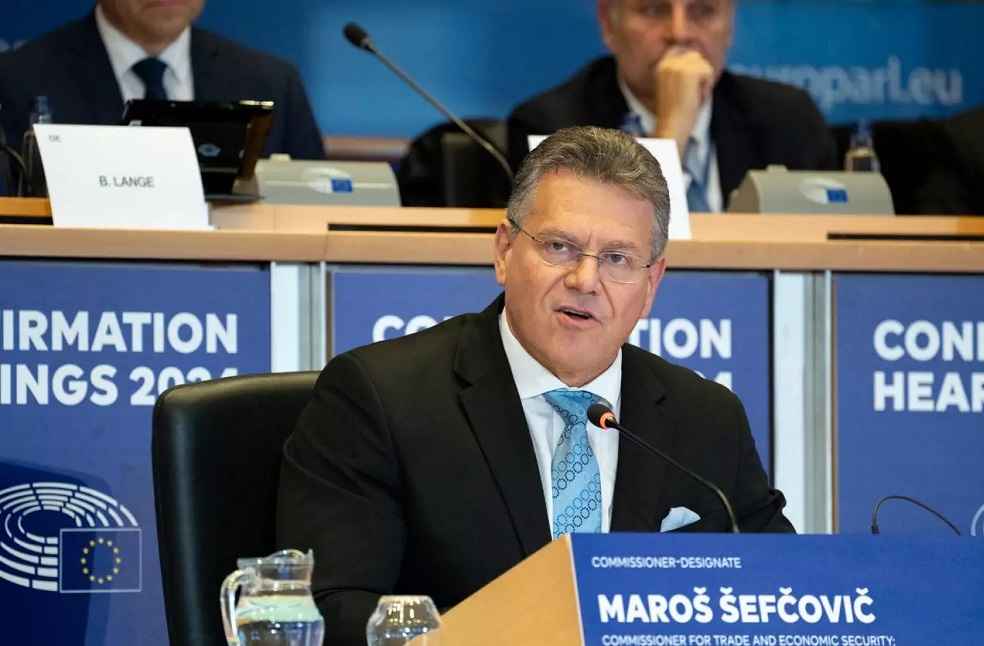
European Union trade chief Maros Sefcovic has warned that the bloc risks falling behind as China reshapes global trade dynamics, arguing that slow investigations and rigid defence tools leave Europe exposed to rising export pressure and state-backed competition.
Speaking before the European Parliament’s trade committee, Sefcovic said the EU’s current approach to trade defence is too slow to respond to Beijing’s expanding industrial capacity and growing surplus.
He highlighted a €360 billion trade deficit with China last year and described the imbalance as unsustainable over the medium to long term. Citing International Monetary Fund data, he said roughly 4% of China’s gross domestic product is channelled into state subsidies, which he argued distort global competition.
The commissioner said Brussels is closely monitoring the increasing presence of Chinese plug-in hybrid vehicles in the European market, as lawmakers debate how to strengthen economic security without triggering escalation.

Although the EU has more than 200 trade defence investigations underway, Sefcovic acknowledged that typical probes can take more than a year, often requiring formal complaints from companies and limiting the bloc’s ability to respond quickly to market disruption.
His remarks come amid broader debate in Brussels over how to adapt trade rules to a changing global environment, where overcapacity, state intervention, and uneven enforcement challenge the level playing field that has underpinned the World Trade Organization system for decades.
The EU has recently circulated proposals suggesting that most-favored-nation trading terms should be earned rather than automatically granted, signalling a potential shift in global trade norms.
Sefcovic said he plans to raise concerns over market access, rare earth export controls, and industrial overcapacity when he meets Chinese Commerce Minister Wang Wentao at the WTO Ministerial Conference in Cameroon next month.
Despite reduced political engagement between Brussels and Beijing, trade and competition investigations targeting sectors such as wind turbines, fast fashion, and telecommunications equipment have accelerated this year.
The European Commission is also preparing new industrial measures, including a proposed Industrial Accelerator Act that could introduce local content requirements of up to 70% for public procurement in strategic sectors such as electric vehicles, effectively creating a stronger preference for European suppliers in state-funded projects.
Lawmakers also questioned Sefcovic about the EU-U.S. trade agreement reached last summer. The European Parliament has paused ratification after a U.S. Supreme Court ruling invalidated President Donald Trump’s earlier tariffs and his subsequent move to introduce a new global import duty.
Sefcovic defended the agreement, arguing that it prevented a potential trade war and protected jobs and industrial stability across the bloc.
He also revealed that coordination with Washington helped resolve last year’s Nexperia semiconductor supply dispute, after China lifted export controls following diplomatic engagement involving both the EU and the United States. According to Sefcovic, the episode demonstrated that supply chain challenges require close transatlantic cooperation even as geopolitical tensions rise.
Overall, the commissioner warned that global overcapacity, non-transparent state intervention, and evolving trade policies are reshaping the international trading system, and said the EU must move faster to safeguard competitiveness while maintaining open markets.
STOCK MARKET | European Stocks Rise as U.S. Tariffs Start at Lower 10% Rate