


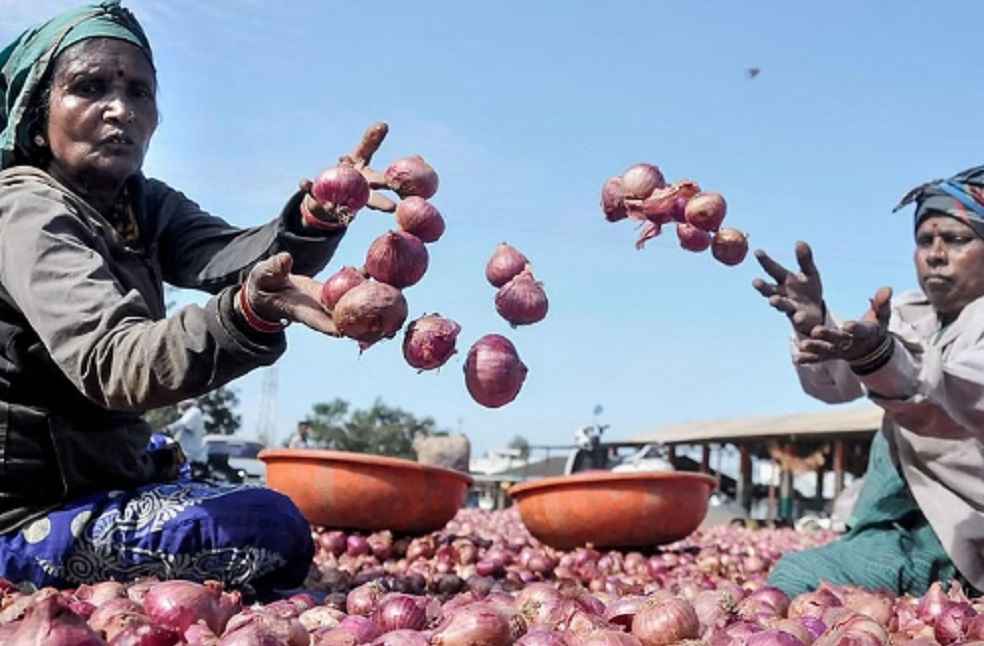
Onion prices across Nashik district have dropped sharply after Bangladesh suspended the issuance of new import permits for onions from India, a move that exporters and farmers say could result in losses of ₹175 to ₹200 crore for growers in the region.
The Bangladesh government has stopped granting fresh import approvals for onions entering through the Hili Land Port, one of the key border routes for agricultural trade between the two countries. Imports under permits already issued will continue only until January 30, after which no further shipments are expected unless restrictions are lifted.
Currently, about 1,500 tons of onions are exported daily from Nashik to Bangladesh through around 50 to 55 trucks. With new permits halted, export volumes are expected to decline sharply, adding pressure to domestic markets already dealing with heavy arrivals.

Prices have fallen across major agricultural markets in the district, including the Lasalgaon Agricultural Produce Market Committee (APMC), Asia’s largest onion market. Traders report that increased inflow of red onions, combined with weak export demand, has led to intense price pressure not only in Nashik but also in several other producing regions.
Over the past 15 days, nearly 20 lakh quintals of onions have arrived at various market committees in Nashik district. Based on current price levels, farmer losses are estimated at ₹175 to ₹200 crore, according to local market assessments.
“With large arrivals of red onions, the restrictions imposed by Bangladesh on new import permits could severely impact exports,” said Vikas Singh, an onion exporter from Nashik. He added that exporters are already seeing reduced movement across the border, which is directly affecting farmgate prices.

Farmers say the current rates do not cover rising input costs. “Production costs have increased, but onions are not fetching expected prices. The slowdown in exports has directly affected farmers, and current market rates are clearly loss-making,” said Nivrutti Nyaharkar, a farmer from Wahegaon Sal village.
Bangladesh authorities said the decision was taken to protect domestic onion growers and stabilize local prices. While allowing shipments under existing permits for a limited period, the government has made it clear that no new import licenses will be issued for now.
Exporters also point to the broader political and economic uncertainty in Bangladesh as an additional factor restricting trade flows. Combined with domestic oversupply in India, the export curbs have intensified market volatility.
Nashik is India’s largest onion-producing region and plays a central role in the country’s export supply chain. Any sustained disruption in cross-border trade is expected to have a significant impact on farmer incomes, market stability, and price recovery prospects in the coming weeks.
DON’T MISS IT | Japan Seeks Smooth Trade as China Delays Imports, Rare Earths