


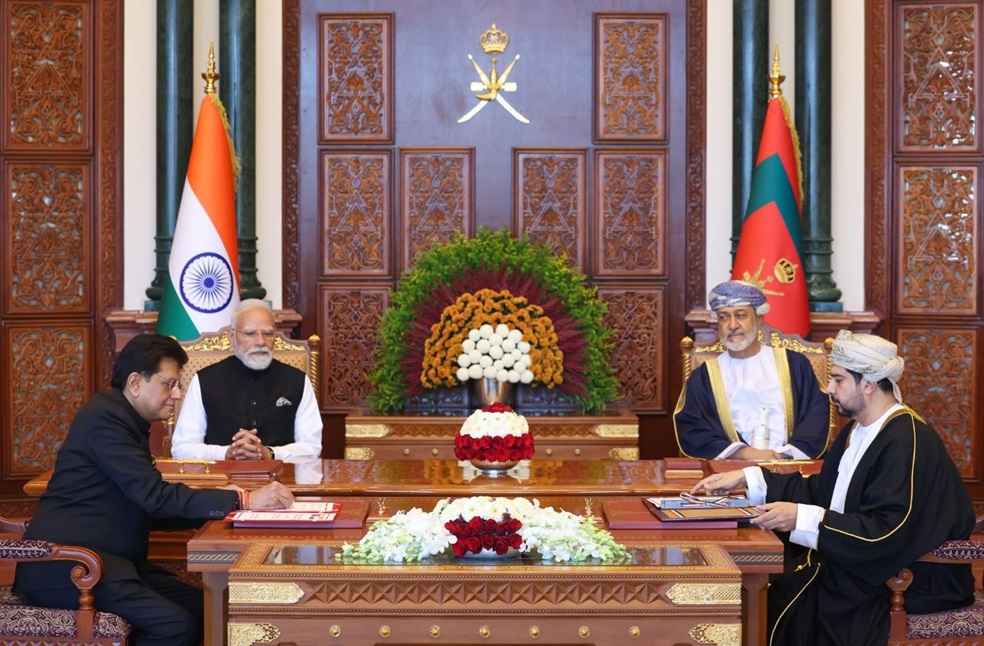
India and Oman inked a Comprehensive Economic Partnership Agreement (CEPA) on Thursday, granting duty-free access to more than 98% of Indian exports to Oman.
India, in turn, has liberalized tariffs on 77.79% of its total tariff lines, covering 94.81% of imports from Oman. Beyond eliminating tariffs on goods, the agreement also offers various concessions aimed at boosting India’s service sector, including provisions for worker mobility.
The agreement was signed in Muscat by India’s Commerce and Industry Minister Piyush Goyal and Oman’s Minister of Commerce, Industry, and Investment Promotion, Qais bin Mohammed Al Yousef, in the presence of Indian Prime Minister Narendra Modi.
This marks Oman’s first bilateral agreement with any country since its 2006 deal with the U.S. It is also India’s second agreement with a Gulf Cooperation Council (GCC) nation, following its pact with the U.A.E. in February 2022.

Under the agreement, Oman will provide duty-free access on 98.08% of its tariff lines, covering 99.38% of India’s exports by value, with immediate tariff removal on 97.96% of those lines. Currently, Oman’s import duties range from 0% to 100%, with higher levies on items such as meat, wine, and tobacco.
In exchange, India has liberalized tariffs on 77.79% of its tariff lines, covering 94.81% of imports from Oman by value, while excluding sensitive sectors such as dairy, tea, coffee, rubber, tobacco, bullion, jewelry, footwear, and sports goods. For sensitive items of interest to Oman, India’s concessions are mainly provided through tariff-rate quotas.
India’s labor-intensive industries, including textiles, leather, footwear, gems and jewelry, engineering goods, plastics, furniture, agricultural products, pharmaceuticals, medical devices, and automobiles, will receive full tariff elimination.
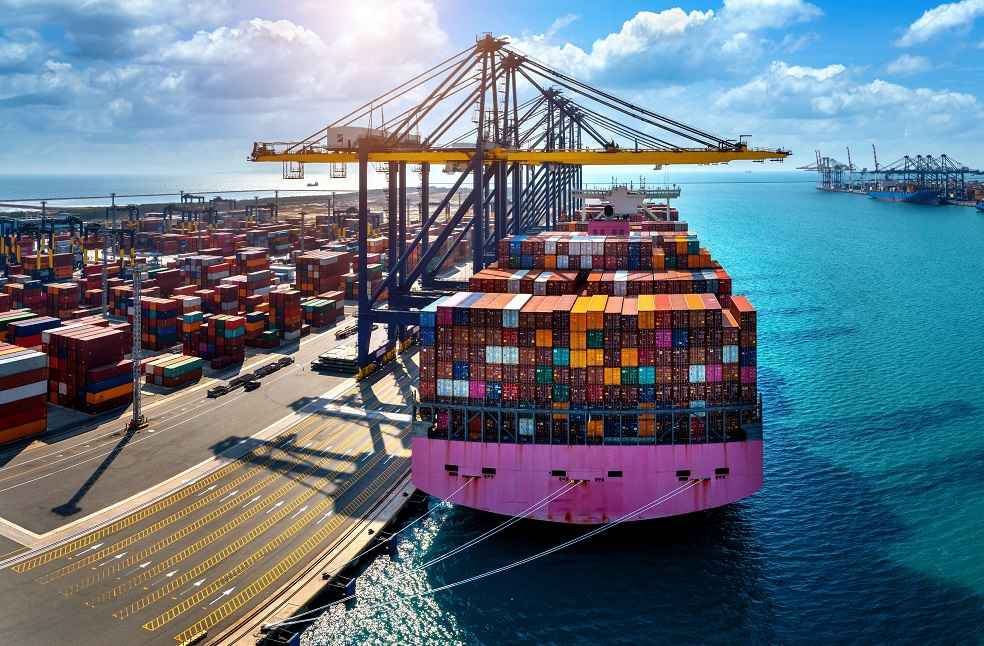
Petroleum products, India’s largest export to Oman at $1.43 billion, are largely already duty-free. Key sectors such as engineering goods ($812.2 million), chemicals ($241.4 million), and partially duty-bearing mineral products like mica, coal, and other ores ($428.6 million) are expected to benefit directly from the tariff reductions.
A major provision of the CEPA is Oman’s most extensive services commitments to date, granting market access across 127 sub-sectors, including IT services, business and professional services, audiovisual services, research and development, education, and healthcare.
The pact also provides extensive mobility benefits for Indian professionals under Mode 4, including increased quotas for intra-corporate transferees, extended stays of up to two years for contractual service providers, and easier entry for professionals in fields such as accountancy, taxation, architecture, and medical and allied services.
Additionally, Oman has pledged to allow 100% foreign direct investment (FDI) by Indian firms in key services sectors.

Oman’s global services imports amount to $12.52 billion, with India currently accounting for 5.31%, underscoring what officials see as substantial untapped opportunities for Indian service providers.
The CEPA also introduces mutual recognition for Halal certification, acceptance of India’s National Programme for Organic Production (NPOP) certification for organic goods, and strengthened cooperation on standards and conformity assessment, addressing long-standing non-tariff barriers. Exporters noted that the agreement could reduce trade costs and create new duty-free market opportunities for India’s micro, small, and medium enterprises (MSMEs) as well as agricultural producers.
Beyond tariff concessions and wider market access, both nations stated in a joint declaration that they will explore new investment opportunities in infrastructure, manufacturing, logistics, technology, food security, and hospitality, supported by the Oman–India Joint Investment Fund.

Both nations also agreed to broaden energy cooperation beyond traditional oil and gas to include green hydrogen, green ammonia, and renewable energy, along with joint investments and technology partnerships.
Bilateral trade between India and Oman reached around $10.5 billion in 2024–25, with India exporting goods worth $4 billion and importing $6.54 billion.
Oman ranks as India’s third‑largest export market within the GCC. This marks India’s second trade agreement in six months, with negotiations also underway with Qatar and other GCC members, including Bahrain, Kuwait, and Saudi Arabia.
The pact comes as India faces steep 50% tariffs in its largest export market, the U.S., underscoring the importance of diversifying trade partnerships.
TEXTILE & APPAREL | Bangladesh Garment Exports may Lose EU Duty‑Free Access After 2029

