


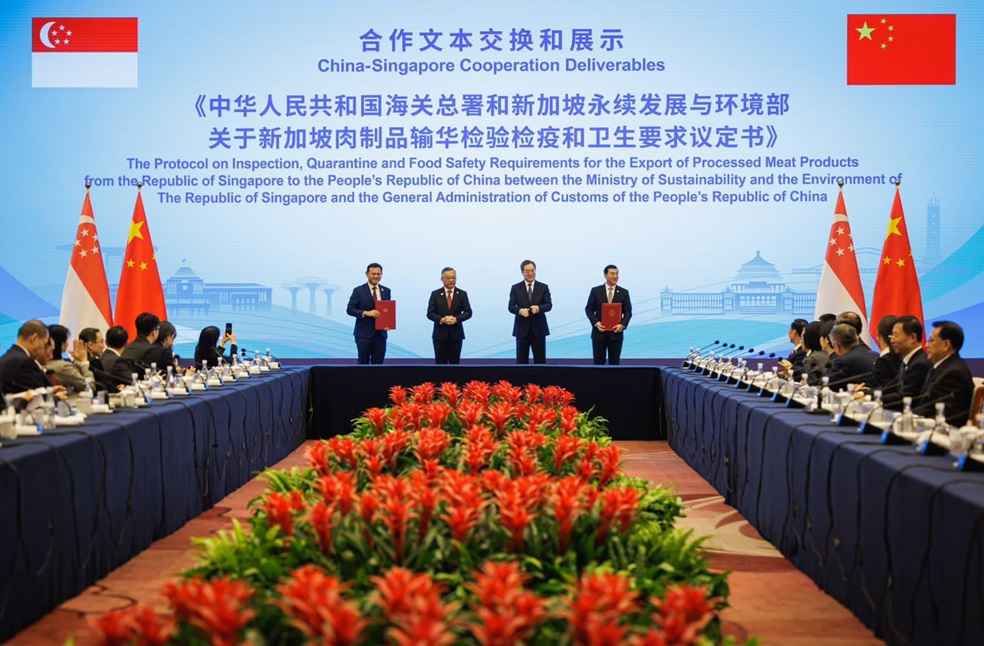
Singapore and China finalized 27 agreements at their annual summit, strengthening collaboration in financial connectivity, green and digital initiatives, and the education sector.
The series of memoranda of understanding (MOUs) and agreements—now totaling 27, up from 25 last year—were revealed on Monday during the 21st Joint Council for Bilateral Cooperation (JCBC) meeting.
The meeting was jointly led by Singapore’s Deputy Prime Minister Gan Kim Yong and China’s Vice Premier Ding Xuexiang. It represents the top-level bilateral engagement between Singapore and China.
A major focus of this year’s meeting was the China-Singapore (Chongqing) Demonstration Initiative on Strategic Connectivity (CCI), now marking its 10th year. Launched in November 2015, the CCI is one of three flagship government-to-government projects, alongside the Suzhou Industrial Park (SIP) and the Tianjin Eco-City. Since its inception, the initiative has enabled $21.8 billion in cross-border financing for businesses in Chongqing and western China via Singapore.

Both countries signed new agreements outlining the vision and roadmap for the CCI, setting long-term goals to steer the initiative into its next decade.
In its next phase, the CCI will expand collaboration into emerging sectors such as education, technology, and healthcare, while further strengthening its four core areas: financial services, aviation, transport and logistics, and information and communications technology, alongside the CCI-New International Land-Sea Trade Corridor (CCI-ILSTC).
Plans include developing Chongqing and Singapore’s role as major aviation hubs, improving logistics to expand the corridor’s reach, and exchanging best practices in healthcare.
Singapore and China will further promote the digital and green development of the CCI-ILSTC, a trade corridor that enables the movement of various goods—including automotive parts, electronics, and chemicals—between western China and Southeast Asia via Singapore.

Efforts will also focus on introducing carbon tracking and providing support for enterprises in areas such as green finance and digital trade.
Beyond the CCI, Singapore and China signed several agreements in the financial and digital economy sectors.
DBS has been named Singapore’s second Renminbi (RMB) clearing bank, supporting the expansion of the offshore RMB market and easing the currency’s use in trade and investment.
By the end of 2025, a pilot scheme will be launched by the end of 2025, allowing them to open and top up e-CNY wallets for merchant payments in China.
Additionally, an upgraded MOU was signed to further facilitate trade and enhance trade security, building on a 2019 agreement aimed at boosting collaboration between Singaporean and Chinese customs authorities.
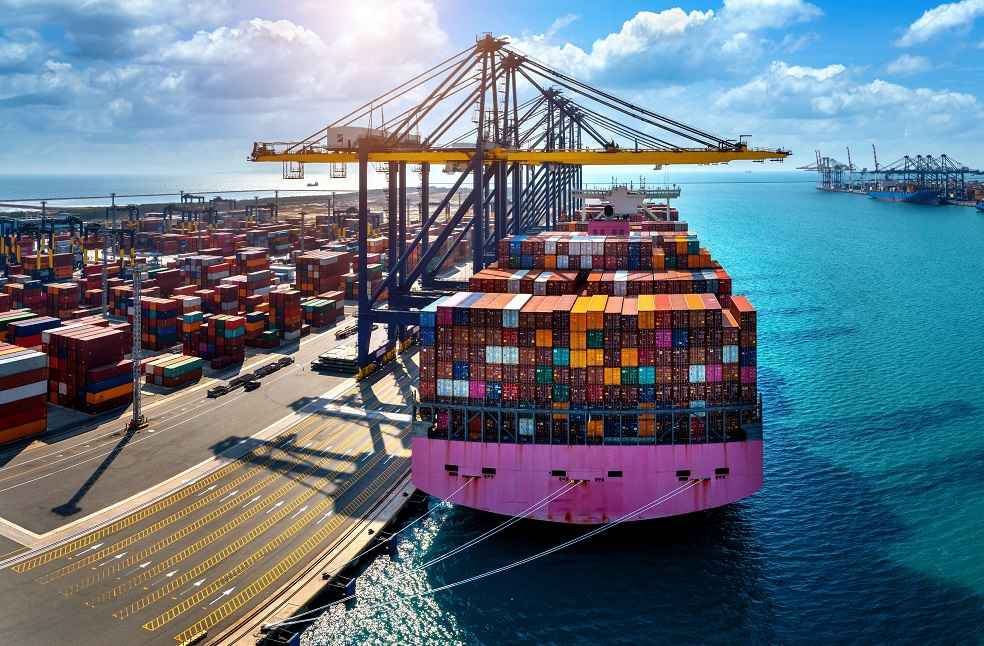
To strengthen bilateral food trade, China will ease market access for Singapore-based food manufacturers to export processed meat products, while Singapore has approved exports of processed meat from Chongqing, Heilongjiang, and Hunan.
Additionally, Singapore signed a new agreement with Tianjin to boost economic cooperation and support key growth sectors, including advanced manufacturing, shipping, biomedical sciences, and tourism.
Both countries emphasized the importance of deepening collaboration to advance their development priorities and promote regional stability.
TRADE WORLD | IMF Urges Pakistan to Review Import Data After Major Discrepancies