


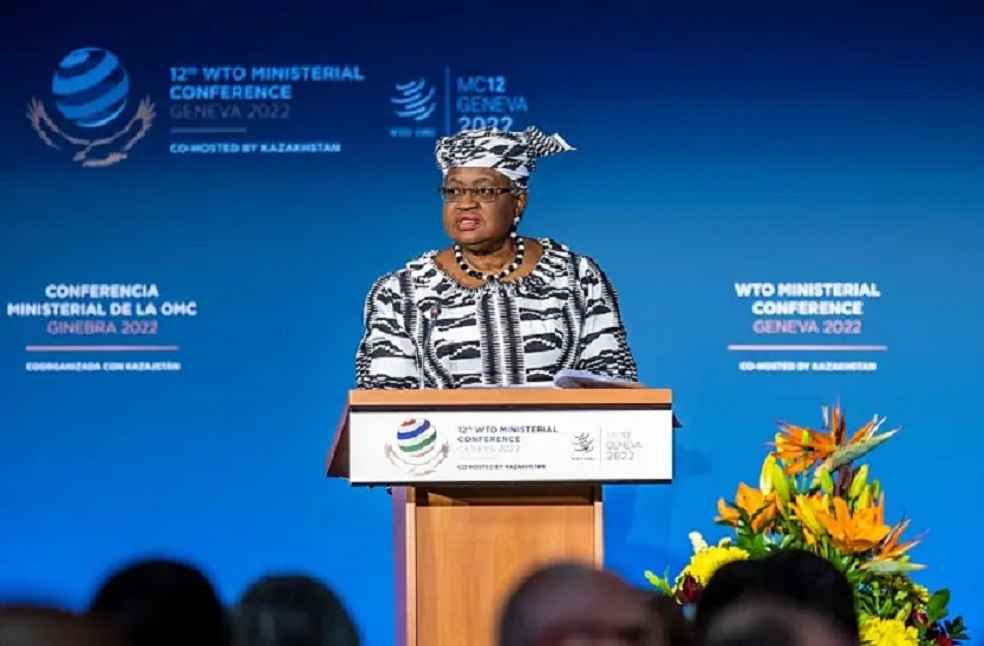
World Trade Organization (WTO) Director-General Ngozi Okonjo-Iweala has warned that the global trading system is facing its most serious disruption since World War II, as the share of global trade conducted under the organization’s Most Favored Nation (MFN) principle has dropped to 72% from around 80%.
According to WTO data cited by Reuters, the decline follows U.S. President Donald Trump’s renewed push to impose higher tariffs on most trading partners. The MFN principle, a cornerstone of the WTO framework, requires member states to treat each other equally in terms of tariffs and access. Its weakening raises concerns about the 30-year-old institution’s ability to uphold free trade and rules-based order.
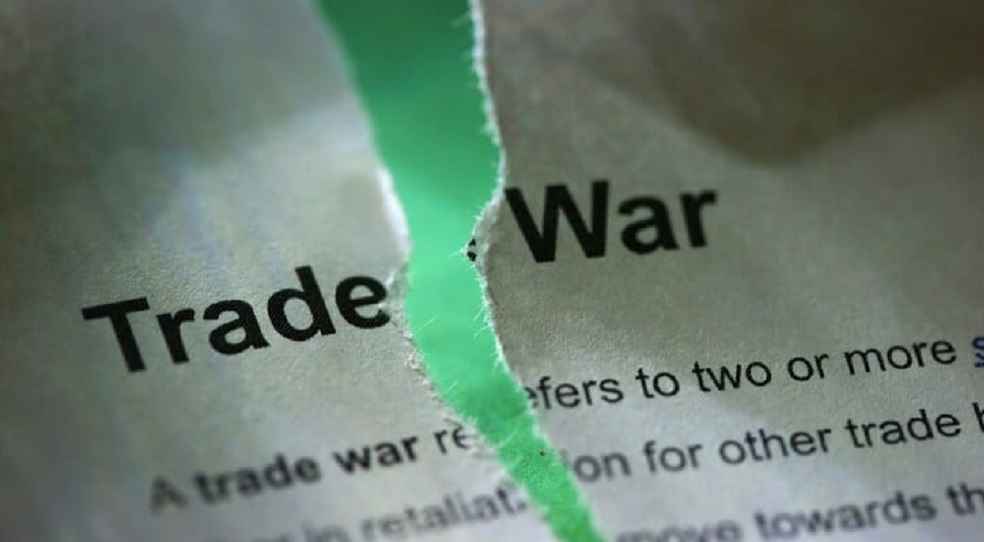
While stressing that the majority of global trade still operates under MFN terms, she acknowledged that the WTO has limited power when tariffs are used as geopolitical tools.
Okonjo-Iweala cautioned that the impact of tariffs may be felt more strongly from 2026, once the frontloading of goods seen in early 2025, driving a short-term trade surge, subsides. The WTO recently raised its 2025 trade growth forecast from 0.2% to 0.9% but noted that the pace may ease as inventories are depleted.
The WTO chief also voiced concern over Washington’s plans to cut $29 million in funding to the organization, which represents about 11% of its $232 million annual budget. While discussions are ongoing with the U.S. Trade Representative, the prospect of reduced U.S. support adds further uncertainty to the body’s future.

Tensions between Trump and the WTO leadership date back to 2020, when his administration opposed Okonjo-Iweala’s appointment, favoring a South Korean candidate instead. Her confirmation as the first woman and first African to lead the WTO only came after U.S. opposition was reversed under the Biden administration. Analysts believe this history underscores why Trump remains unsympathetic to her concerns over his tariff policies.
Despite these challenges, Okonjo-Iweala remains focused on WTO reform. She pointed to an emerging openness from China to address industrial policies as a possible breakthrough, alongside efforts by members such as Britain, Australia, and the UAE to push forward constructive proposals. Reform discussions include streamlining decision-making and addressing subsidies to ensure fairer competition.
“I’m done with pessimism. I am done with fear. What we need to do is look at optimism and those who are trying to actually solve problems,” she said.
MOST POPULAR | UNCTAD Warns Policy Uncertainty Threatens Global Trade
