


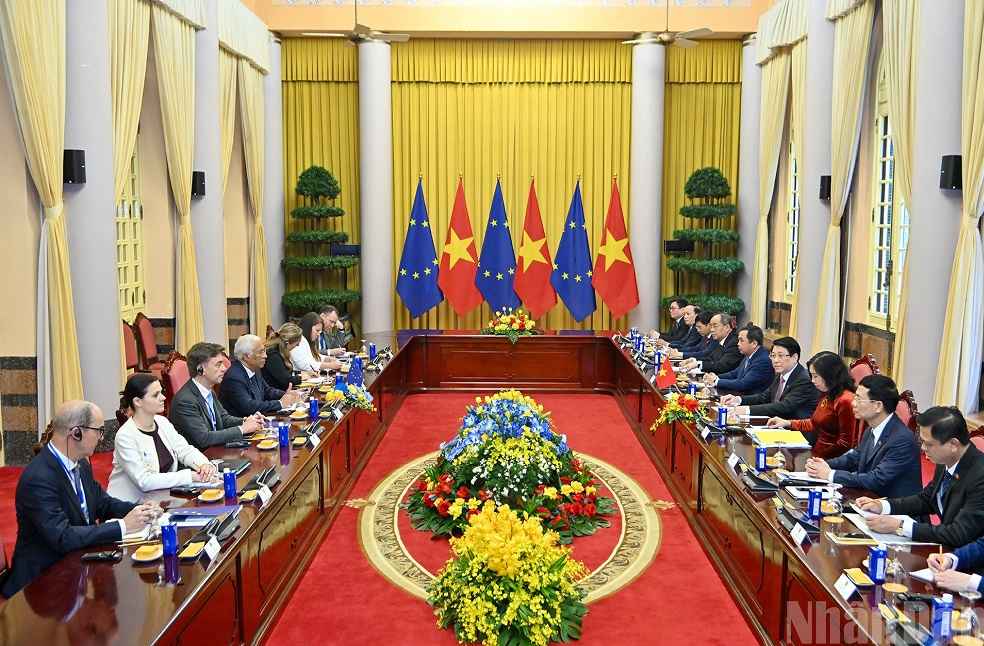
Vietnam and the European Union have upgraded their relationship to a comprehensive strategic partnership, the highest level in Vietnam’s diplomatic framework, as both sides adjust trade and investment strategies amid disruptions to global commerce driven by U.S. tariff pressures.
The upgrade was announced on Thursday during a visit to Hanoi by European Council President António Costa, placing the EU on the same diplomatic footing as the United States, China, and Russia in Vietnam’s foreign policy hierarchy.
“At a moment when the international rules-based order is under threat from multiple sides, we need to stand side by side as reliable and predictable partners,” Costa said, adding that the partnership aims at “developing spheres of shared prosperity.”
Costa’s visit to Vietnam followed a separate milestone earlier in the week, when India and the European Union concluded a free trade agreement after nearly two decades of negotiations, underscoring the bloc’s broader push to deepen economic ties across Asia.
Vietnamese President Luong Cuong described the upgrade as a ‘historic milestone,’ highlighting its strategic significance for the country’s long-term development agenda.
The announcement comes less than a week after Vietnam re-elected Communist Party General Secretary To Lam as the country’s top leader, reaffirming his reform-driven strategy focused on accelerating economic growth and expanding international partnerships.
Vietnam has been a major beneficiary of globalization, emerging as a key manufacturing and export hub for electronics, garments, and consumer goods as multinational companies shifted production away from China.
Export-led growth has lifted incomes and reshaped the economy, but Vietnam’s large and persistent trade surplus has drawn criticism, particularly from the United States and increasingly from European policymakers concerned about market access and competitive balance.
For the European Union, the upgraded partnership strengthens engagement with one of Asia’s fastest-growing manufacturing centers and supports efforts to diversify supply chains at a time of rising geopolitical and trade tensions.
Bilateral trade between Vietnam and the EU reached more than $66.8 billion in the first 11 months of 2025, an increase of 6.6% from a year earlier. The EU is Vietnam’s fourth-largest trading partner, third-largest export market, and fifth-largest source of imports, while Vietnam is the EU’s largest trading partner in Southeast Asia.
Vietnam is aiming to sustain growth and become a high-income economy by 2045 and is actively seeking to expand market access beyond the United States, which remains its largest export destination, absorbing around 30% of Vietnamese exports.
The two sides have been linked by a free trade agreement since 2020, providing a foundation for deeper economic integration under the upgraded partnership.
IMEX SECTOR | Pakistan Urges Türkiye to Increase Rice Imports Amid Price Pressure