


Global trade and economic growth are expected to weaken as geopolitical instability and financial pressures intensify, according to the latest annual assessment from the UN Conference on Trade and Development (UNCTAD).
The report, released on December 2, shows global trade rose by about 4% early this year, supported by firms accelerating imports ahead of expected tariff hikes, rising investment in AI, and stronger flows between developing economies.
When stripping out these temporary factors, underlying trade growth is estimated at just 2.5 to 3% and is projected to soften further.
UNCTAD expects global economic growth to slow to 2.6% in 2025, down from 2.9% in 2024. The agency said trade and investment are increasingly constrained by financial volatility and geopolitical uncertainty, with growth now trending below the pre-pandemic average of 3% and well below the 4.4% seen before the 2008–09 financial crisis.
A continued deceleration into late 2025 and 2026 reflects broader structural challenges, UNCTAD said, aligning with the World Trade Organization’s latest indicators, which also point to weaker momentum due to higher tariffs and persistent trade policy uncertainty.
Low-income economies and small businesses remain the most vulnerable as limited access to finance and ongoing uncertainty restrict long-term planning and investment.
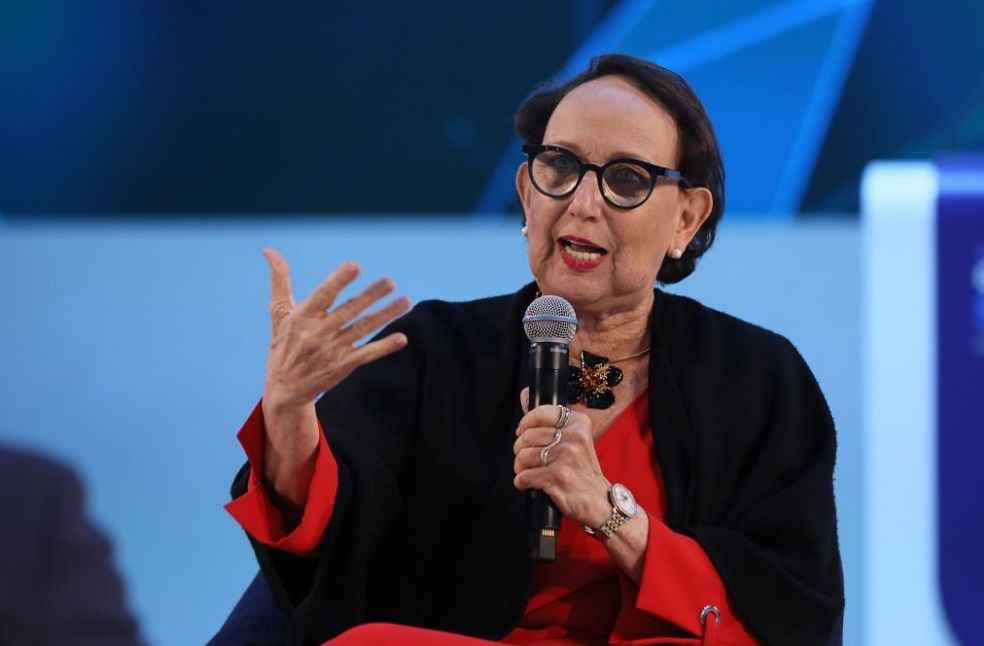
UNCTAD Secretary-General Rebeca Grynspan told reporters in London that financial conditions now play a decisive role in shaping global trade, describing the trend as the “financialization of trade.”
She noted that trade has become increasingly sensitive to interest-rate changes and shifts in investor sentiment because “90% of trade now depends on finance,” including banks, payment systems, and financial instruments like derivatives.
Despite the pressures, UNCTAD highlighted stronger participation from developing economies. South–South trade reached $2.87 trillion between January and July 2025, up 4.7% from the same period last year, and is expected to outperform overall global trade growth this year.
Developing countries continue to face higher financing costs, exposure to sudden capital movements, and rising climate-related financial risks.
The report stresses that the global South now accounts for more than 40% of world output, nearly half of merchandise trade, and over half of investment inflows, yet holds limited influence in global financial markets.
Grynspan said this imbalance leaves developing countries particularly exposed to tariff impacts and at risk of becoming more reliant on commodities.
UNCTAD is calling for modernized global trade rules that reflect today’s digital economy, climate priorities, and new industrial strategies.
It urged reforms to the international monetary system to reduce harmful currency swings and volatile capital flows, along with efforts to deepen regional and domestic capital markets, improve transparency in commodity trading, and expand affordable trade finance, especially for small businesses.
POLICY & LAW | UN Adds Australian Leaf-Tailed Geckos to Trade Protections