


Following the Trump–Albanese minerals pact announced last week, the Export–Import Bank of the United States (U.S. Exim) has issued $2.2 billion in letters of interest to fund seven Australian critical-minerals projects.
The move signals the first phase of implementation under the bilateral framework. The LOIs were issued to Arafura Rare Earths, Northern Minerals, Graphinex, La Trobe Magnesium, VHM, RZ Resources, and Sunrise Energy Metals.
These projects focus on key minerals such as rare earth elements, graphite, magnesium, titanium, and scandium, all vital for defence systems, aerospace, advanced communications, and next-generation industrial technologies.
The letters were signed in Washington, D.C., on October 20 by U.S. Exim Chairman John Jovanovic and Australian Minister for Resources Madeleine King.
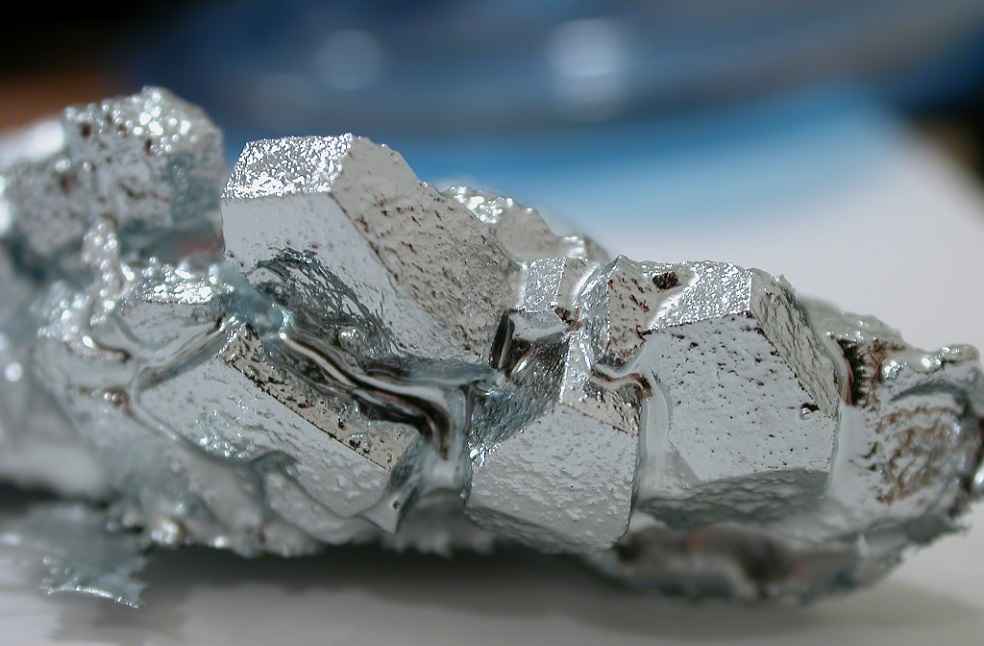
The announcement underscores Washington’s growing interest in strengthening supply chain resilience and reducing reliance on Chinese-sourced critical minerals.
“Under President Trump’s leadership to strengthen U.S. national security and economic resilience, Exim is proud to issue more than U.S. $2.2 billion in letters of interest advancing critical minerals and supply chain security projects between the United States and Australia,” said Jovanovic.
“Each of these projects reflects our commitment to enhancing supply chain resilience, revitalizing domestic manufacturing, and creating high-quality U.S. jobs,” he added.
Six of the seven projects are being developed in partnership with Export Finance Australia (EFA) under the joint U.S. Exim-EFA ‘single point of entry’ framework established in 2023 and activated in 2024.
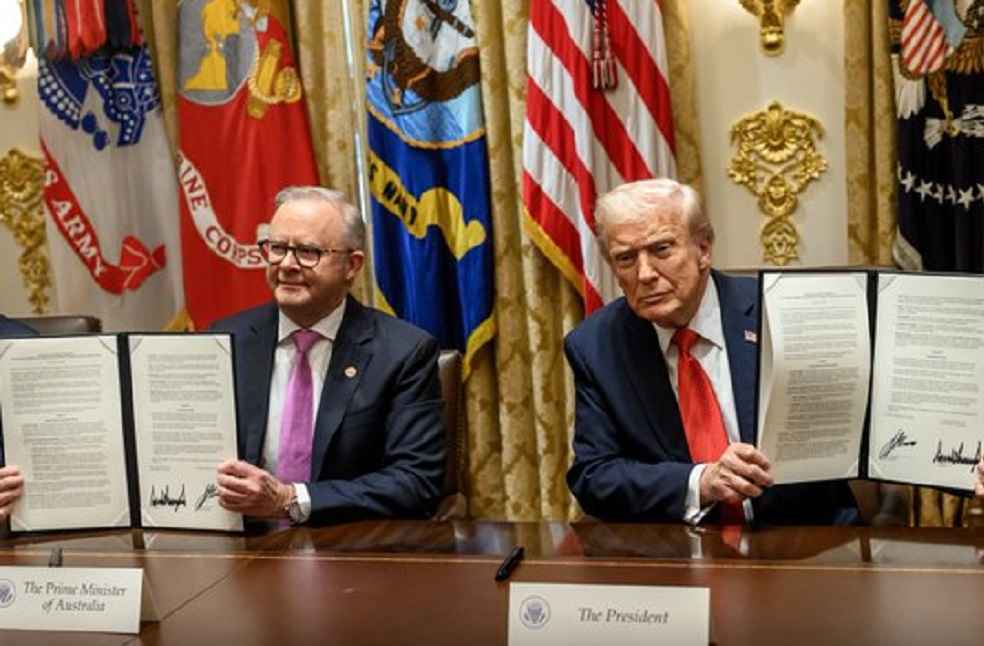
The new U.S.-Australia critical minerals pact commits each government to provide at least $1 billion in financing over the next six months, with a combined investment of $3 billion toward projects requiring $8.5 billion in total capital expenditure.
The Chamber of Minerals and Energy of Western Australia welcomed the initiative, calling it a “game-changing” step that positions Australia as “a critical minerals supplier of choice to the world’s biggest economy.”
Industry analysts highlight that the timing aligns with global concerns over supply constraints. A recent McKinsey study estimated that nearly $5 trillion in capital investment will be needed to meet future demand for key minerals such as copper, nickel, and lithium, as supply struggles to keep pace with the world’s energy transition goals.
LEADERS SPOT | Trump, Albanese Seal Major U.S.-Australia Minerals Pact