


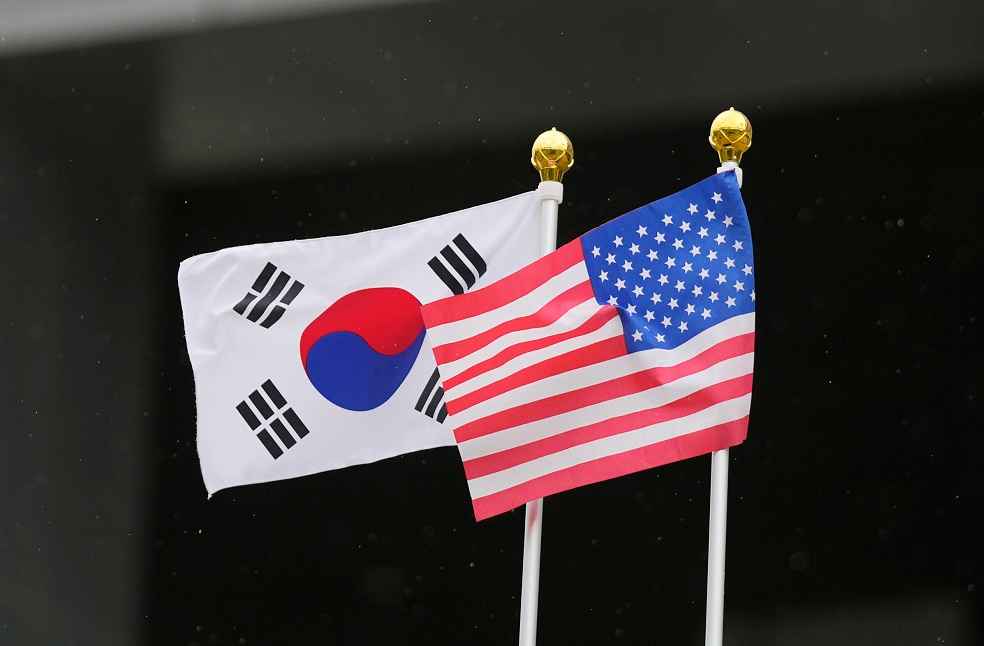
The U.S. and South Korea have released the terms of a wide-ranging trade agreement involving major Korean investments in U.S. industries, tariff reductions, and new cooperation across defence, technology, and energy.
The deal centers on a planned $150bn Korean investment in U.S. shipbuilding and a further $200bn in strategic funding for key industrial sectors.
The announcement follows the October meeting between South Korean President Lee Jae Myung and U.S. President Donald Trump, during which both sides agreed to bring U.S. import tariffs on Korean products down to 15% from 25%.
South Korea had been concerned about steep duties on major exports such as cars and semiconductors. Industry Minister Kim Jung-kwan and U.S. Commerce Secretary Howard Lutnick have since signed a memorandum of understanding outlining a 27-point investment framework.
Under the agreement, project selections will be made by President Trump after consultations with officials in Seoul, and South Korea will release funds within 45 days of each decision.
The $200bn package will be deployed in annual tranches capped at $20bn to avoid putting pressure on the Korean currency. Both governments have agreed that the investments should not unsettle financial markets, and Seoul may request changes to the pace or size of funding if needed.
The plan includes partnerships across AI, shipbuilding, nuclear energy, critical minerals, semiconductors, pharmaceuticals, and wider industrial development.
A White House fact sheet confirmed that Washington has approved Seoul’s ambition to build nuclear-powered submarines and will assist in securing the required fuel supplies.
South Korea will also purchase $25bn in U.S. military equipment by 2030 and provide $33bn in broader support for U.S. Forces Korea.
The trade package includes a significant easing of automotive rules. The U.S. will cut tariffs on Korean vehicles to 15%, while South Korea will scrap its limit on imports of U.S. cars that comply with Federal Motor Vehicle Safety Standards.

Seoul will also accept U.S. emissions documentation without demanding additional testing. Both governments have committed to clearer regulatory pathways for biotechnology products and to resolving non-tariff barriers in agriculture, with market access for U.S. meats, cheeses, and horticultural goods explicitly protected.
Digital trade is another area of focus. The agreement commits both countries to ensuring that U.S. companies are not disadvantaged by network usage fees, data-transfer rules, or other digital-services regulations in South Korea.
Shipbuilding cooperation will expand through a joint working group tasked with repairs, maintenance, workforce development, supply-chain strengthening, and modernization of U.S. shipyards.
The initiative includes the possibility of constructing U.S. vessels in South Korea to accelerate fleet growth for commercial and military needs. The U.S. has also agreed, within legal limits, to support South Korea’s plans for civil uranium enrichment and spent-fuel reprocessing for peaceful purposes.
President Trump additionally announced new trade deals with Argentina, El Salvador, Guatemala, and Ecuador. These agreements cover security cooperation and economic initiatives intended to expand supply chains and generate more export opportunities for U.S. producers across Central and South America.
GLOBAL EVENTS | Amsterdam Hosts Major Global Bulk Wine Exhibition 2025