


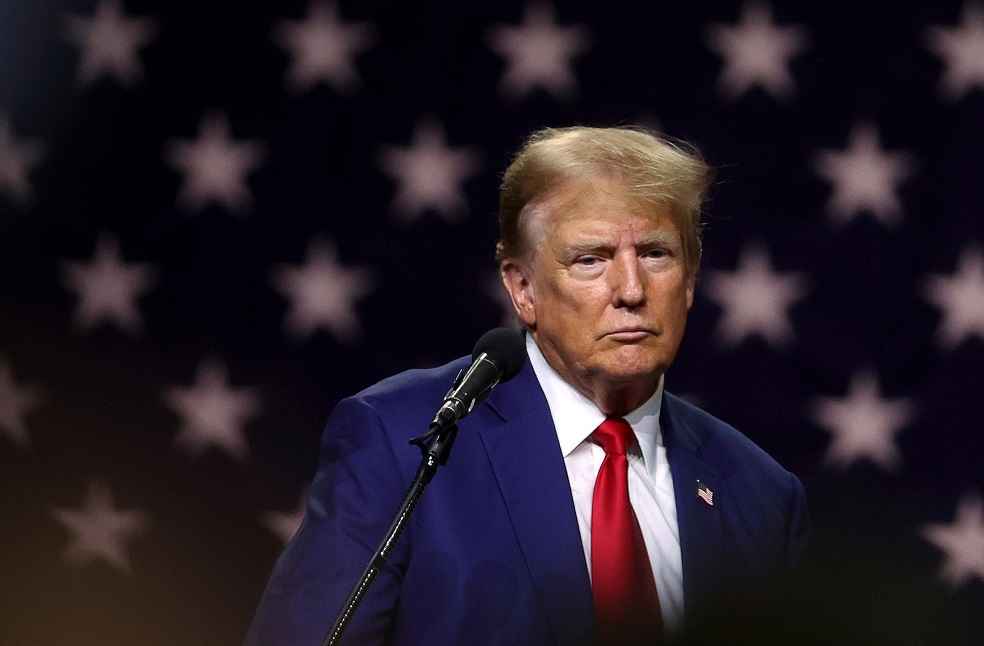
U.S. President Trump on Friday signed a proclamation imposing a 10% tariff on imports to the country, just hours after the Supreme Court struck down a set of sweeping global tariffs his administration imposed under the national security law.
“It is my great honor to have just signed, from the Oval Office, a global 10% tariff on all countries, which will be effective almost immediately,” Trump wrote on Truth Social.
The new tariffs will take effect on Tuesday and remain in place for 150 days. Certain foreign products, such as specific food items, essential minerals, electronics, and vehicles, are exempt from the 10% duty. Additionally, goods from Canada and Mexico that fall under the trade agreement negotiated during Trump’s first term are also excluded from the tariffs.

Friday’s tariffs are implemented under a separate law, Section 122 of the Trade Act of 1974, which allows the president to impose duties of up to 15% for 150 days to address ‘large and serious’ balance-of-payment problems. The move reflects Trump’s effort to revive the global system of high tariffs and trade agreements that are central to his economic agenda.
The new tariffs replicate the 10% baseline rate that Trump introduced last spring on goods from numerous trading partners.
Under Trump’s previous tariff program, trading partners faced even higher rates, including a series of ‘reciprocal’ tariffs on multiple countries and tariffs on goods from China, Canada, and Mexico. Some nations were able to negotiate lower rates through broader trade agreements.
However, all these measures were based on the Trump administration’s interpretation of IEEPA, which the Supreme Court invalidated on Friday.

Meanwhile, the Supreme Court’s ruling did not affect tariffs imposed under legal authorities other than IEEPA, such as Trump’s steel, aluminum, and auto tariffs tied to national security concerns. However, the decision poses a significant setback to Trump’s economic agenda, as the tariffs had been projected to generate nearly $3.6 trillion in revenue between 2026 and 2035, according to Oxford Economics.
In January, Trump warned that if the Court struck down the tariffs, the United States could face repayments amounting to hundreds of billions of dollars. He noted that this figure excludes potential compensation claims from countries and companies that had invested in new plants, factories, and equipment to avoid tariff costs.
Factoring in such investments, the financial burden could reach trillions, creating a complex situation that might take years to resolve. Trump also argued that such a ruling would seriously undermine the U.S.’s trade policy based on national security considerations.
POLICY & LAW | U.S. and Indonesia Finalize Trade Agreement with Tariff Cuts