


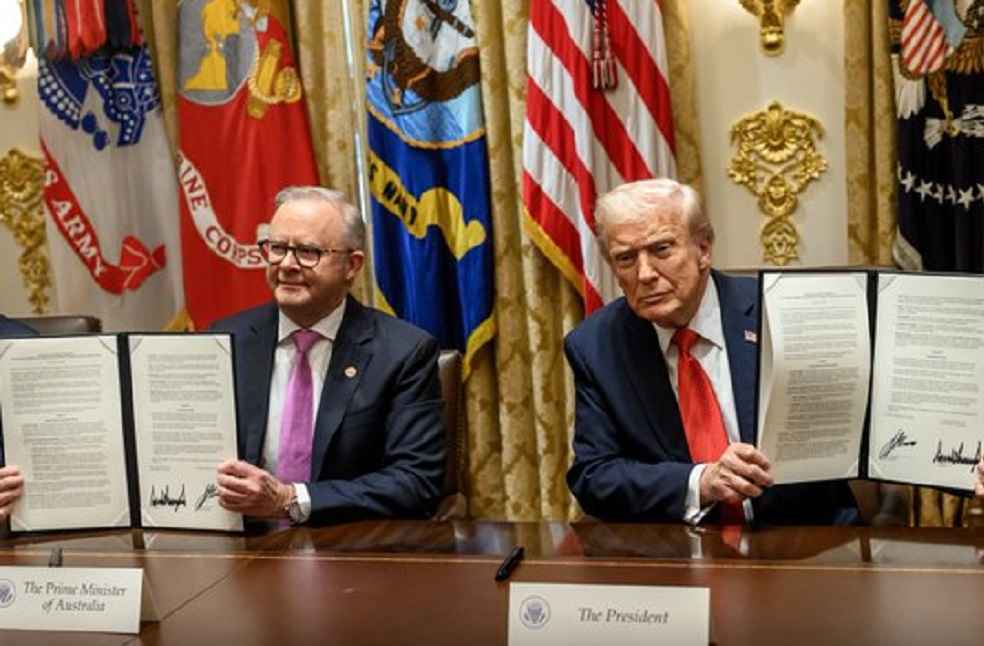
U.S. President Donald Trump and Australian Prime Minister Anthony Albanese have signed a major critical minerals pact to strengthen cooperation. This deal marks Washington’s efforts to reduce reliance on China’s near-monopoly over global supply chains.
The agreement was finalized on Monday during Albanese’s visit to the White House after months of negotiation.
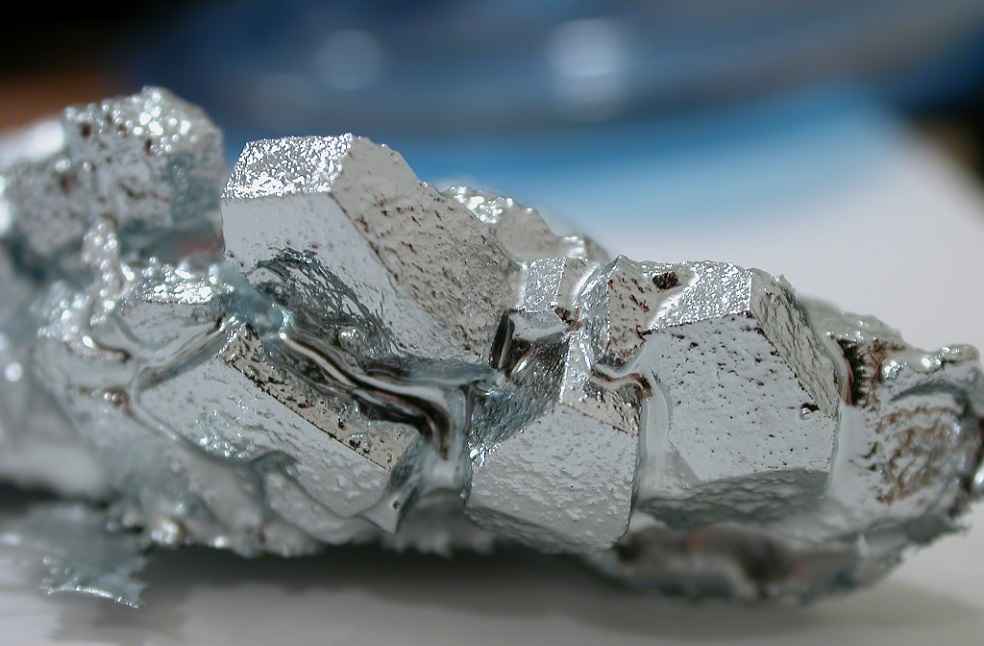
Under the agreement, the United States and Australia will jointly invest more than $3 billion over the next six months in critical mineral projects. It includes the construction of an advanced gallium refinery in Western Australia capable of producing 100 metric tons per year.
The recoverable resources from these projects are estimated at $53 billion, according to the White House.
“In about a year from now, we’ll have so much critical mineral and rare earths that you won’t know what to do with them,” Trump said during the announcement.
The deal comes amid intensifying global competition for resources essential to modern technology, defence systems, and clean energy.
China currently dominates the market, accounting for roughly 85% of global rare-earth processing and 92% of magnet production. These materials are crucial to the U.S. military and advanced manufacturing sectors.
Australia, however, remains one of the world’s largest producers of lithium, cobalt, tungsten, and other critical minerals. The U.S. hopes to leverage Australia’s abundant resources to diversify supply chains and reduce dependence on Beijing.
The signing follows heightened trade tensions after China restricted the export of key minerals earlier this month. In response, Trump threatened to impose 100% tariffs on Chinese goods starting November 1.
Australia, too, has sought to diversify its export markets despite China remaining its largest trading partner, primarily through iron ore and coal exports.
Beyond mineral cooperation, Trump and Albanese also discussed expanded defence collaboration, including the AUKUS trilateral nuclear submarine pact with the United Kingdom.
The AUKUS deal, valued at nearly $240 billion, involves Australia purchasing U.S. nuclear-powered submarines in 2032 and later co-developing a new class of submarines with Britain.
While the new agreement represents a major step in U.S.-Australia strategic alignment, it remains uncertain whether it will lead to a reduction in U.S. tariffs on Australian goods.
Current American tariffs include a 10% baseline on most imports, 50% on steel, aluminium, and some copper products, 25% on auto parts and wooden furniture, and 10% on softwood lumber.
The new minerals partnership underscores both nations’ shared commitment to building secure, sustainable supply chains and deepening cooperation in technology, trade, and defence amid rising geopolitical tensions with China.
POLICY & LAW | Pakistan Revises Barter Trade Framework to Ease Trade Hurdles
