


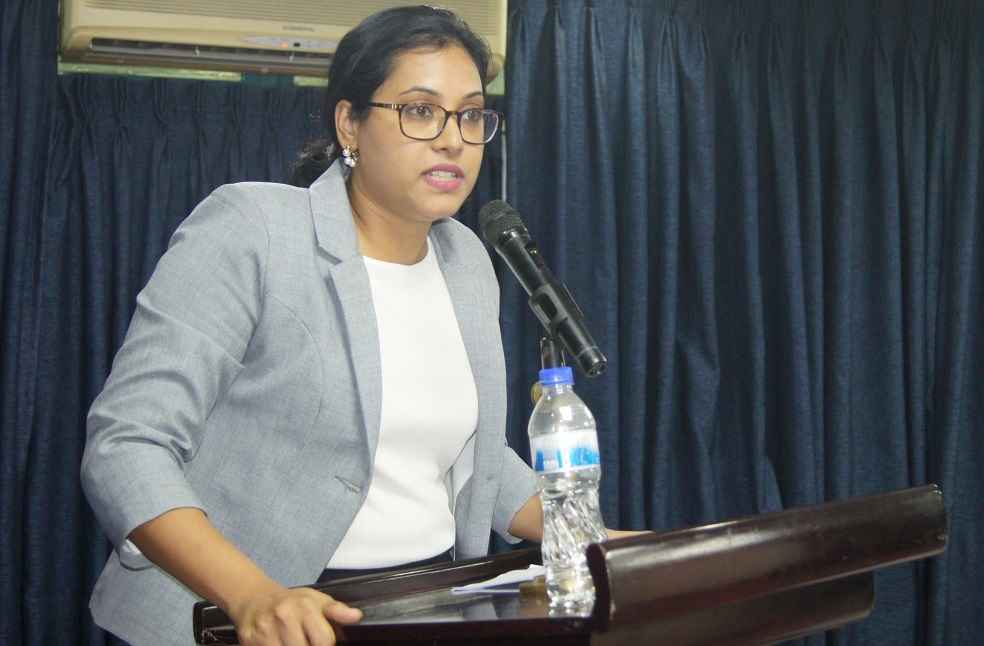
Economist and Arutha Research Director, Civic Education, Rehana Thowfeek, has urged Sri Lanka to abandon its inward-looking economic approach and commit to an open trade policy if it hopes to avoid recurring financial crises.
Speaking at the Annual Conference on Public Sector Reforms for Economic Revival, organized by CA Sri Lanka and the Association of Public Finance Accountants of Sri Lanka, Thowfeek emphasized that the country has no choice but to trade its way to recovery.
“Trade for Sri Lanka is not just about growth anymore. It is about survival,” she said. “The fuel queues, gas shortages, and medicine crises of 2022 were all connected to our inability to earn enough foreign exchange through trade.”
Thowfeek explained that Sri Lanka’s long-standing balance of payments deficit stems from imports consistently exceeding exports. “Before the default, we spent 30 to 35% of our export revenues just on debt servicing,” she said.
She added that with public debt exceeding 100% of GDP before the 2022 default and projected to remain around 92% by 2030 even after restructuring, the only sustainable path is through economic expansion.
“We cannot meaningfully reduce our nominal debt stock, so the only way forward is to grow the denominator, GDP, by expanding industries, exports, and jobs.”
Reflecting on Sri Lanka’s economic trend, Thowfeek said the country has repeatedly failed to learn from history. “By 1977, Sri Lanka was a closed economy with high tariffs, rationing, and foreign exchange controls. Liberalization changed that trajectory, transforming exports into an engine of growth and shifting the economy from agriculture to manufacturing,” she noted.
She cautioned that over the past two decades, the nation has moved back towards protectionism. “There has been a noticeable shift towards para-tariffs and import restrictions that created an anti-export bias, making it more profitable to sell domestically than to export,” she said.
This policy reversal, she added, has led to a stagnant export base. “The share of exports in GDP has fallen from around 30% at the start of the millennium to about 20% in recent years. Our export basket is still dominated by apparel, tea, and rubber, and our markets are concentrated in the U.S., UK, and EU.”
Comparing Sri Lanka’s progress with that of regional peers, Thowfeek highlighted how Vietnam and Cambodia, despite liberalizing later, have surged ahead by embracing global integration. “High-tech exports make up just 1.5% of Sri Lanka’s manufactured exports, compared to 46% in Vietnam and over 50% in Malaysia and Singapore,” she said.
“These countries attracted foreign investment, integrated into supply chains, and signed effective trade agreements. We did the opposite, and the results are clear.”
Thowfeek warned that Sri Lanka’s retreat into protectionism has left it vulnerable. “By 2022, we had import bans, exchange controls, and even talk of self-sufficiency. Exports have stagnated, and our lack of diversification has made us fragile.”
She stressed that citizens ultimately want simple outcomes from economic policy: better jobs, stable prices, and a decent standard of living.
Rehana called for trade policies that serve trade objectives rather than narrow fiscal interests. “There is a national export strategy in the works, but the real test will be implementation. We need fewer bureaucratic procedures, more digitization, and improved infrastructure,” she said.
She also proposed a dedicated institution for trade negotiations to ensure proper execution of agreements, similar to structures in successful exporting nations.
Thowfeek further underscored the importance of expanding trade agreements, strengthening education, and preparing for technological change. “We must reskill people, including those in the public sector, and prepare for the Artificial Intelligence revolution. We need to move up the value chain and target high-tech exports,” she said.
In 2024, Sri Lanka exported $12.7 billion worth of goods and services and imported $18.8 billion, resulting in a $6 billion trade deficit. “We can’t close that gap by borrowing. We have to earn our way out by trading more, producing more, and integrating better,” Thowfeek said.
She also warned of increasing global risks. “When the U.S. imposed a 44% tariff on Sri Lankan exports earlier this year, later reduced to 20%, it showed how vulnerable we are because 25% of our exports go to the U.S. If we dislike the U.S. imposing tariffs on our exports, why do we do the same to others? Is that fair?”.
IMEX SECTOR | Bangladesh Approves Major U.S. Wheat Import Deal