


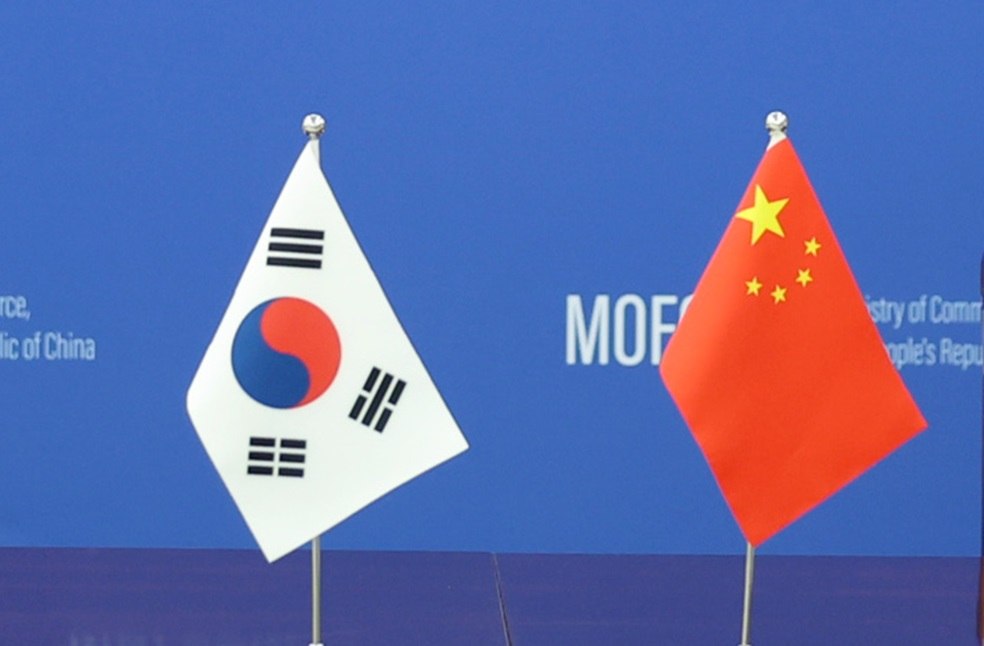
Korean and Chinese trade officials met Tuesday to explore ways to speed negotiations on the second phase of their bilateral free trade agreement, with a focus on boosting cooperation in services and investment, according to Seoul’s trade ministry.
Korea’s Trade Minister Yeo Han-koo held talks with his Chinese counterpart, Li Chenggang, in Beijing, the Ministry of Trade, Industry, and Resources said.
The initial stage of the FTA, implemented in December 2015, removed tariffs on major goods. At that point, both nations consented to partially open their services and investment sectors and committed to beginning follow-up negotiations within two years.
The ministry said Tuesday that both sides agreed to begin holding regular face-to-face meetings with all relevant government bodies from next year to resolve outstanding issues.

They also decided to schedule another ministerial-level trade meeting in the first half of next year, enabling senior trade officials to directly assess the progress of negotiations.
According to South Korea’s Ministry of Trade, Industry and Resources (MOTIR), on December 28, bilateral trade between the two countries increased by roughly 20%, rising from $227.4 billion in 2015 to $272.9 billion last year. Korean exports to China became more diversified, including semiconductors, automobiles, biopharmaceuticals, and cosmetics, while Korean consumers gained from a wider range of low-cost Chinese products.
However, overall trade has been shrinking since reaching a peak of $310.3 billion in 2022. By November this year, bilateral trade totaled $242.6 billion, marking a 2.4% drop compared with the same period a year earlier.

Notably, Korea’s trade balance with China has worsened significantly. After a surplus of $55.6 billion in 2018, Korea reported its first trade deficit with China in 31 years in 2023, with a third consecutive annual deficit anticipated this year.
Recognizing the limitations of a trade strategy focused on goods, the Korean government is stepping up efforts to expand collaboration into services and investment. Meanwhile, experts emphasize that talks should also tackle supply chain resilience for vital minerals like rare earths and reinforce safeguards for intellectual property rights.
If the second phase of the FTA is finalized, market access is anticipated to extend beyond manufactured and agricultural products to include service and investment sectors such as finance, telecommunications, and legal services.
LOGISTICS INDUSTRY | Gansu Connectivity Opens New Routes for Europe-China Trade