


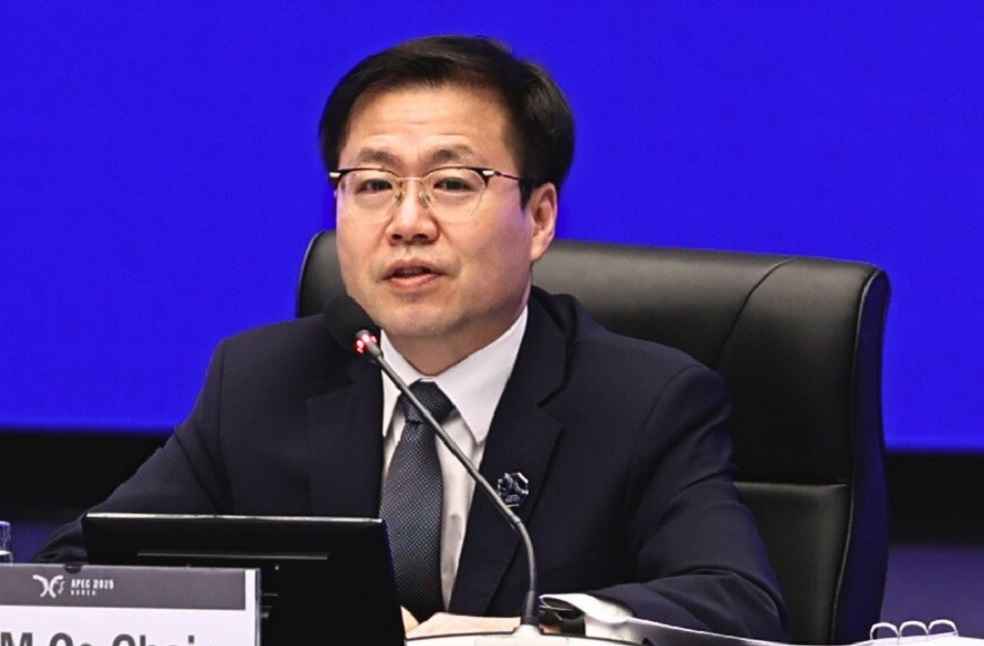
Korea’s Trade Minister Yeo Han-koo has urged Asia-Pacific Economic Cooperation (APEC) members to embrace open plurilateralism and strengthen collaboration in artificial intelligence (AI) and clean energy to address growing challenges in the global economy.
Speaking at the APEC Ministerial Meeting (AMM) in Gyeongju on Thursday, Yeo highlighted the region’s central role in global trade and production, noting that APEC economies account for 61% of global GDP and 49% of world trade.
“Amid profound shifts in the global economy, there is no better time than now to rekindle the spirit of openness and cooperation,” he said.
The two-day ministerial meeting serves as the final preparatory session ahead of the APEC Leaders’ Summit, bringing together foreign and trade ministers from 21 member economies. Its outcomes are expected to form the basis of the proposed Gyeongju Declaration, which Korea aims to secure through consensus.
Yeo presented three strategic priorities for APEC: advancing open plurilateralism, expanding AI-driven cooperation, and accelerating the energy transition.
He reaffirmed Korea’s firm commitment to a rules-based multilateral trading system under the World Trade Organization (WTO), while advocating flexible and inclusive mechanisms to adapt to global changes.
Emphasizing the importance of innovation, Yeo called on member economies to narrow the digital divide through digital trade and AI partnerships. He also reiterated Korea’s proposal for an ‘AI for Trade’ initiative introduced earlier this year and announced plans to launch an AI for Supply Chains project in 2026.

On energy cooperation, Yeo described the transition toward renewable energy as both a ‘new growth engine’ and the ‘foundation of sustainable prosperity.’
He outlined Korea’s efforts toward carbon neutrality, including the establishment of a new Ministry of Climate, Energy, and Environment and the creation of RE100 industrial complexes to promote renewable energy use.
RE100, short for Renewable Energy 100%, is a global initiative encouraging companies to power all their operations with renewable energy.
“We face economic uncertainty, fragmented supply chains, and an escalating climate crisis, but we must not let these divide us,” Yeo concluded, calling for unity and forward-looking collaboration among APEC economies.
MOST POPULAR | U.S.-China High-Level Talks Secure Tariff Reductions and Trade Deals