


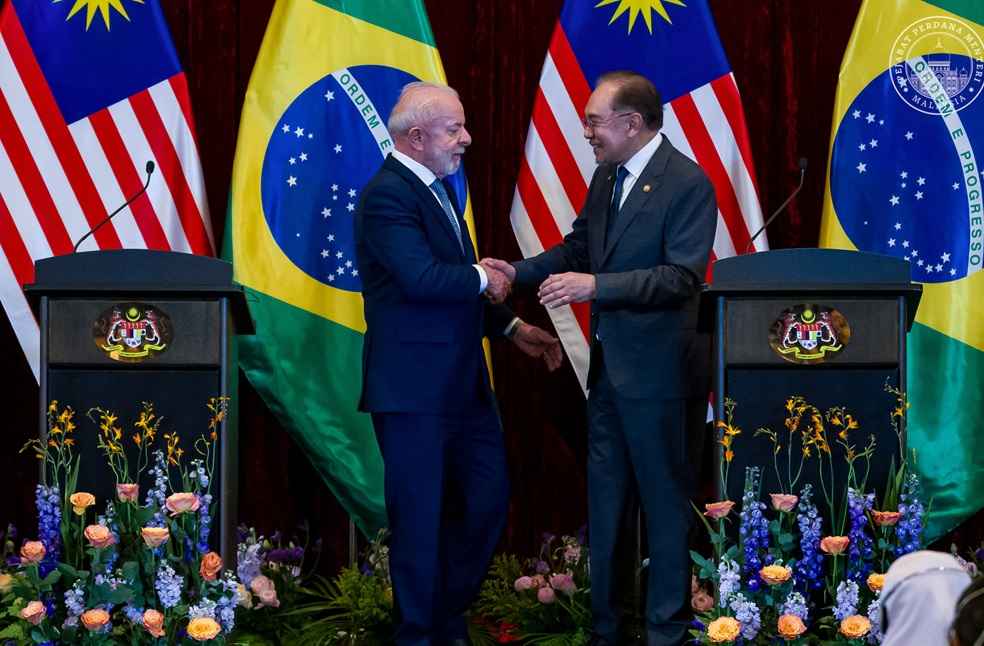
Malaysia and Brazil signed a series of memoranda of understanding (MoUs) on Saturday, representing a major step in enhancing bilateral cooperation across key sectors such as semiconductor technology, science, innovation, and agriculture.
Malaysian Prime Minister Datuk Seri Anwar Ibrahim and Brazilian President Luiz Inácio Lula da Silva attended the ceremony at Kompleks Seri Perdana, held as part of the Brazilian leader’s official visit to Malaysia.
The first MoU was signed by Malaysia’s Investment, Trade, and Industry Minister Tengku Datuk Seri Zafrul Abdul Aziz and Brazil’s Vice Minister of Development, Industry, Trade, and Services Marcio Fernando Elias Rosa to strengthen collaboration in the semiconductor sector.
Subsequently, Malaysian Science, Technology, and Innovation Minister Chang Lih Kang and his Brazilian counterpart, Luciana Barbosa de Oliveira Santos, signed an MoU to enhance bilateral cooperation in science, technology, and innovation.
In addition, an MoU was exchanged between MIMOS Bhd and Brazil’s MDE Instituto Nacional de Pesquisas Espaciais, centered on advancing collaboration in the semiconductor industry.

Institute of Strategic and International Studies (ISIS) Malaysia chairman Professor Dr. Mohd Faiz Abdullah and Brazil’s Minister of Foreign Affairs Mauro Vieira signed another MoU between ISIS Malaysia and the Alexandre de Gusmão Foundation (FUNAG). FUNAG, a think tank linked to Brazil’s Ministry of Foreign Affairs, promotes research, studies, and cultural and educational activities on the history of diplomacy and international relations.
Additionally, a letter of intent was signed between the Malaysian Agricultural Research and Development Institute (MARDI) and the Brazilian Agricultural Research Corporation (EMBRAPA) by MARDI director-general Datuk Dr. Mohamad Zabawi Abdul Ghani and Brazil’s Minister of Agriculture and Livestock Carlos Fávaro.
In 2024, Brazil ranked as Malaysia’s second-largest trading partner in Latin America, with total bilateral trade reaching RM20.36 billion. Malaysia’s exports to Brazil included electrical and electronic products, palm oil, rubber, and halal pharmaceuticals, while imports from Brazil consisted of ores, processed foods, and petroleum products.
POLICY & LAW | China Aims for Balanced Imports and Exports in New Policy

