


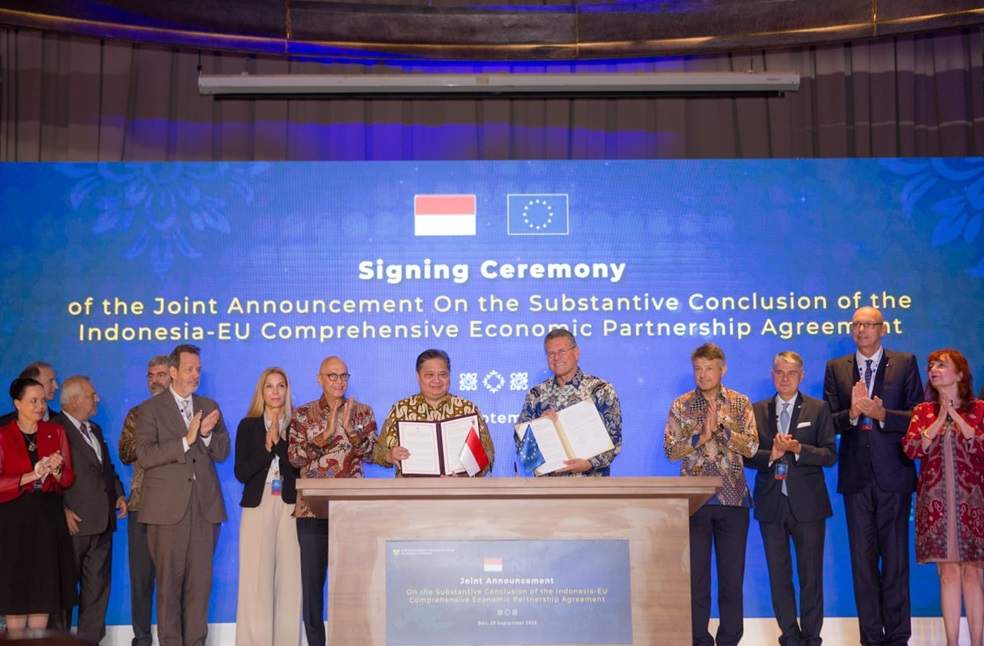
Indonesia and the European Union signed the Indonesia–European Union Comprehensive Economic Partnership Agreement (IEU-CEPA) in Bali on Tuesday, after nearly a decade of negotiations.
The Indonesia–European Union Comprehensive Economic Partnership Agreement marks Brussels’ third trade accord with Southeast Asia, following deals with Singapore and Vietnam.
The agreement was signed by Indonesia’s Coordinating Minister for Economic Affairs, Airlangga Hartarto, and the European Commission’s Commissioner for Trade and Economic Security, Maroš Šefčovič, in the presence of EU member state ambassadors and private sector representatives.
The deal will remove over 98% of tariffs, significantly reducing trade barriers and creating new opportunities for investment. For Jakarta, it provides a crucial boost to exports, especially as Indonesian products currently face U.S. tariffs of up to 19%.
“In all, EU exporters will save some 600 million euros ($708 million) a year in duties paid on their goods entering the Indonesian market, and European products will be more affordable and available to Indonesian consumers,” EU President Ursula von der Leyen said.
Indonesia began trade talks with the EU in 2016, though the negotiations made limited progress in the early stages.
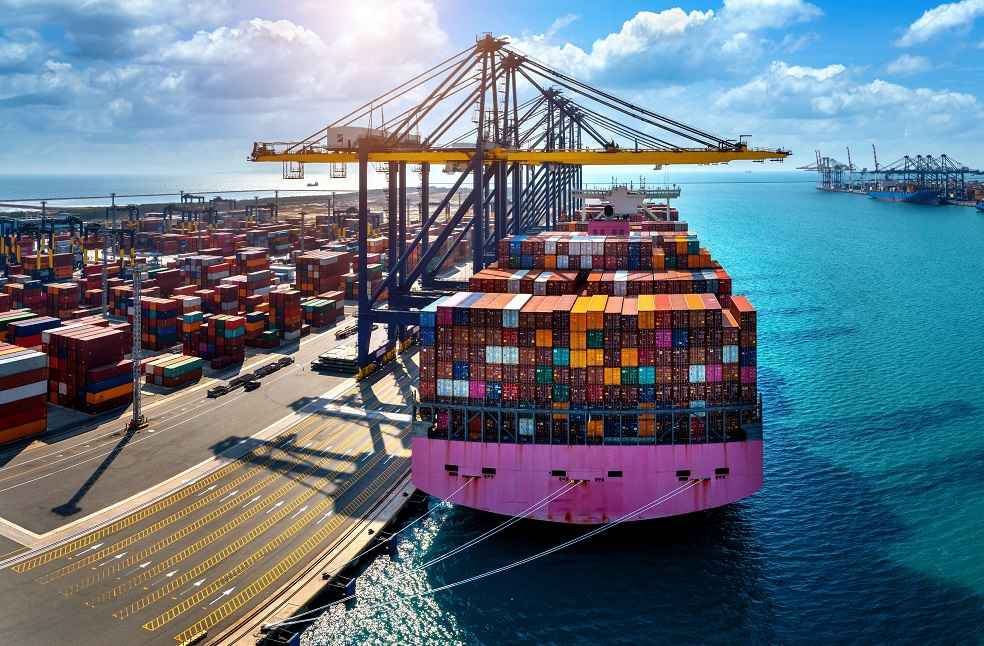
Indonesia is focusing on boosting labor-intensive exports to Europe, including palm oil, textiles, and footwear, while EU industries like agri-food, automotive, and chemicals are expected to benefit from improved market access. Airlangga highlighted that longstanding European concerns about Indonesian palm oil, particularly regarding environmental standards, have been resolved through mutual recognition of regulations.
The agreement also enables deeper collaboration in emerging industries, including electric vehicles, pharmaceuticals, and electronics, and ensures access to essential raw materials vital for green and digital innovation.
Šefčovič described the agreement as ‘a balanced outcome,’ emphasizing that it supports the supply of key raw materials essential for green and digital technologies.
As per the deal, Indonesia will eliminate its 50% import tariff on cars over the next five years, paving the way for increased EU automotive exports and fostering long-term investment in electric vehicle development. As a leading supplier of vital resources such as nickel and copper, Indonesia anticipates that the deal will double trade volumes with the EU within five years, due to broader access to the bloc’s 27-member market.
Under the EU’s deforestation law, products like soy, timber, palm oil, and rubber are banned if sourced from land deforested after December 2020. Airlangga said Šefčovič pledged ‘special treatment’ under this rule for countries with EU trade agreements.
The European Union currently ranks as Indonesia’s fifth-largest trading partner, with bilateral trade exceeding €27 billion last year.
The EU stated that the trade agreement also includes a protocol on palm oil, though it did not disclose specific details. In July, Indonesian President Prabowo Subianto visited Brussels and, alongside EU Commission President Ursula von der Leyen, declared that both nations had reached a ‘political agreement’ to finalize the deal after 19 rounds of negotiations. Minister Airlangga explained that global uncertainties stemming from ‘tariff wars and protectionism’ among major economies had prompted both sides to pursue a stable and predictable bilateral arrangement.
Once the agreement takes effect, around 80% of Indonesian exports to the EU will gain tariff-free access. Major beneficiaries include palm oil, footwear, textiles, and fishery products. The deal also ensures equal legal safeguards for companies from both Indonesia and the European Union.
The agreement now requires approval from EU member states, the European Parliament, and Indonesia’s parliament. Implementation of the comprehensive economic partnership is expected by 2027.
FINTECH | Paysafe Teams Up With CMC Markets to Boost Trading Payments