


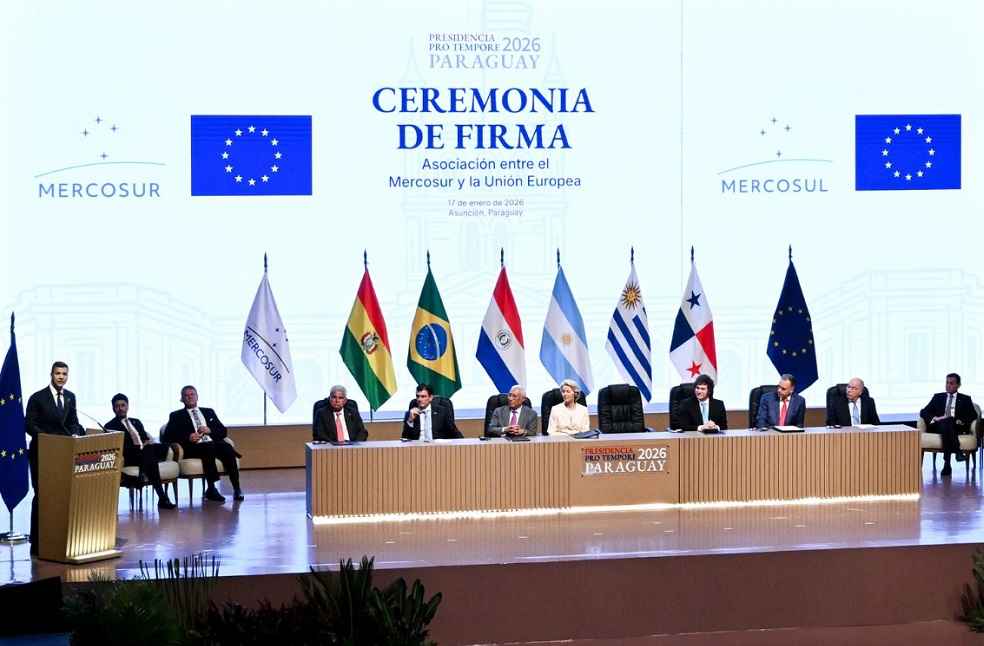
European and South American leaders have signed a landmark free trade agreement between the European Union and the Mercosur bloc, concluding 25 years of negotiations and creating one of the world’s largest trading areas at a time of growing global protectionism and geopolitical uncertainty.
The agreement, finalized on Saturday by the 27-nation EU and Mercosur members Argentina, Brazil, Paraguay, and Uruguay, is expected to become the EU’s largest trade deal once fully ratified. It must still receive approval from the European Parliament and the national legislatures of the Mercosur countries before entering into force, which officials project could happen by the end of 2026.
Speaking at the signing ceremony in Asuncion, EU Commission President Ursula von der Leyen said the pact reflects a clear choice in favor of open markets and long-term cooperation. “We choose fair trade over tariffs, we choose a productive long-term partnership over isolation,” she said.
Paraguayan President Santiago Pena described the agreement as a strong signal of support for international trade in a global environment increasingly shaped by tensions. Brazil’s Foreign Minister Mauro Vieira said the pact would act as a safeguard against what he called a world marked by unpredictability, protectionism, and coercion.
Together, the EU and Mercosur represent around 30% of global GDP and more than 700 million consumers. The treaty eliminates tariffs on more than 90% of bilateral trade, aiming to significantly expand commercial flows between the two regions.
European exporters are expected to benefit from improved access for products such as cars, wine, and cheese, while South American producers will gain easier entry for beef, poultry, sugar, rice, honey, and soya beans.
The deal secured backing from most EU member states last week, despite strong resistance from farming groups and environmental organizations. Critics warn that an influx of cheaper agricultural imports could undercut European farmers and increase pressure on sensitive ecosystems, including risks of higher deforestation.
Thousands of farmers in Ireland staged protests, accusing European leaders of sacrificing domestic agriculture for broader trade objectives.
Supporters argue that the agreement will stimulate economic growth, create jobs, and deepen economic integration across the Atlantic. Leaders in Paraguay said the pact would unlock new opportunities for businesses and consumers in both regions.

Reporting from Asuncion, Al Jazeera’s Latin America editor Lucia Newman said Mercosur countries control vast agricultural output and raw mineral resources that are strategically important to Europe.
She noted that South American governments are eager to access the European market, although the agreement introduces stricter regulatory and environmental standards that will require adjustment by exporters.
Newman also highlighted the geopolitical significance of the agreement, saying it sends a clear message in support of multilateral cooperation at a moment when isolationism and tariff-driven policies are gaining ground globally.
The timing of the signing added to its political symbolism. Shortly before the ceremony, U.S. President Donald Trump announced new tariffs on several European countries following their opposition to his proposal to take control of Greenland.
Trump has not ruled out the use of military force to seize the Arctic territory, which is part of Denmark, prompting international concern and protests.
Against this backdrop, European and South American leaders framed the trade deal as a reaffirmation of open markets, predictable rules, and long-term cooperation in an increasingly fragmented global economic landscape.
TRADE TECH | China’s AI Exports Drive Record Trade Surplus in 2025