


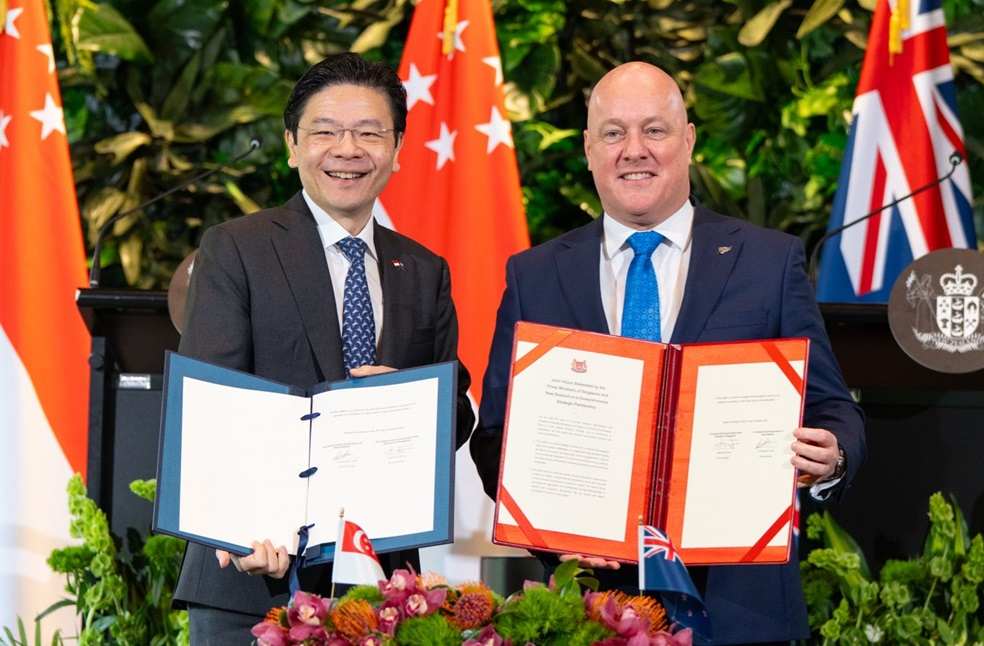
New Zealand and Singapore unveiled a new Comprehensive Strategic Partnership (CSP) on Friday to commemorate 60 years of diplomatic relations between the two nations. New Zealand Prime Minister Christopher Luxon and Singaporean Prime Minister Lawrence Wong jointly revealed the agreement during an event in Auckland.
The Comprehensive Strategic Partnership aims to strengthen collaboration in six major areas: trade and economic relations, defense and security, science and innovation, cultural and social ties, climate and sustainable development, and supply chain resilience and connectivity.
Wong stated that Singapore’s first free trade agreement (FTA) laid the foundation for bolder collaborations between the two island nations. Among these was the Pacific-4 (P4) agreement, which eventually evolved into the Comprehensive and Progressive Agreement for Trans-Pacific Partnership, a trade pact involving 12 countries.
The CSP aims to promote common strategic objectives, such as enhancing regional support through collaborative capacity-building initiatives for Pacific nations, Wong added.

He also noted that since their last upgrade in 2019, the two nations have completed over 40 joint initiatives, and under the CSP, Singapore and New Zealand will embark on even more ambitious and innovative collaborations.
The two countries are also exploring plans for a new multi-nation green economy partnership, building on their collaboration through the Digital Economy Partnership Agreement (DEPA), which was launched in 2020 by Singapore, New Zealand, and Chile.
As part of the Comprehensive Strategic Partnership, Singapore and New Zealand have also signed a trade agreement focused on essential supplies. This legally binds them to take measures that reduce the impact of supply chain disruptions, helping ensure the continued flow of critical goods like food, fuel, and medicine during emergencies.
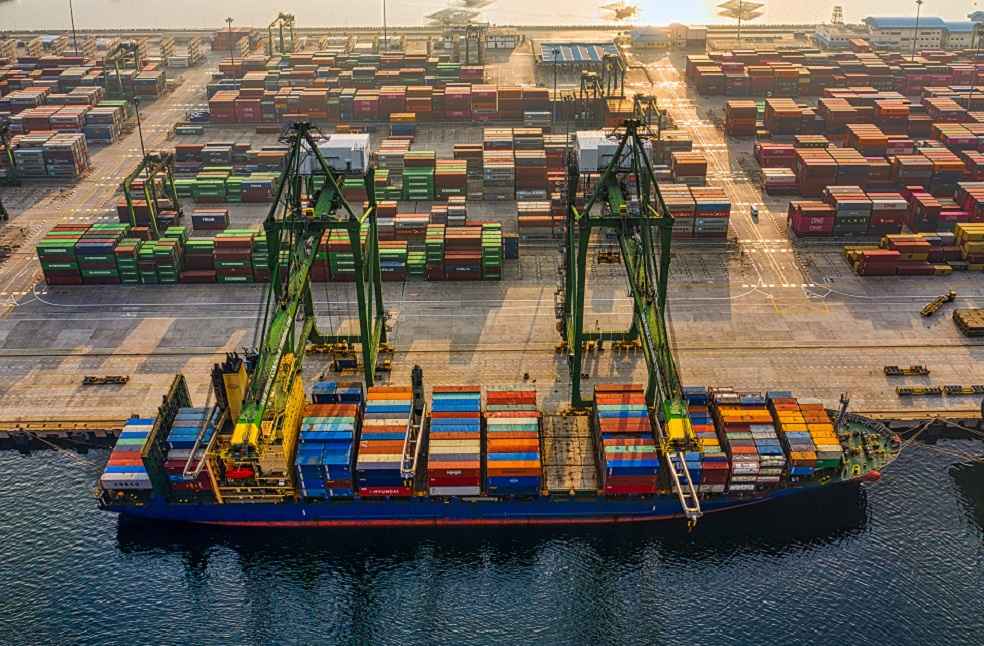
Christopher Luxon highlighted that Singapore is New Zealand’s top trading partner in Southeast Asia and serves as the regional hub for many New Zealand companies. He also remarked that the agreement exemplifies the shared instincts and goals of both nations in pursuing mutually advantageous outcomes, noting that Singapore relies heavily on food imports while New Zealand depends significantly on imported fuel and pharmaceuticals.
ENERGY INDUSTRY | U.S. Imposes New Set of Sanctions Targeting Iran’s Oil Exports