


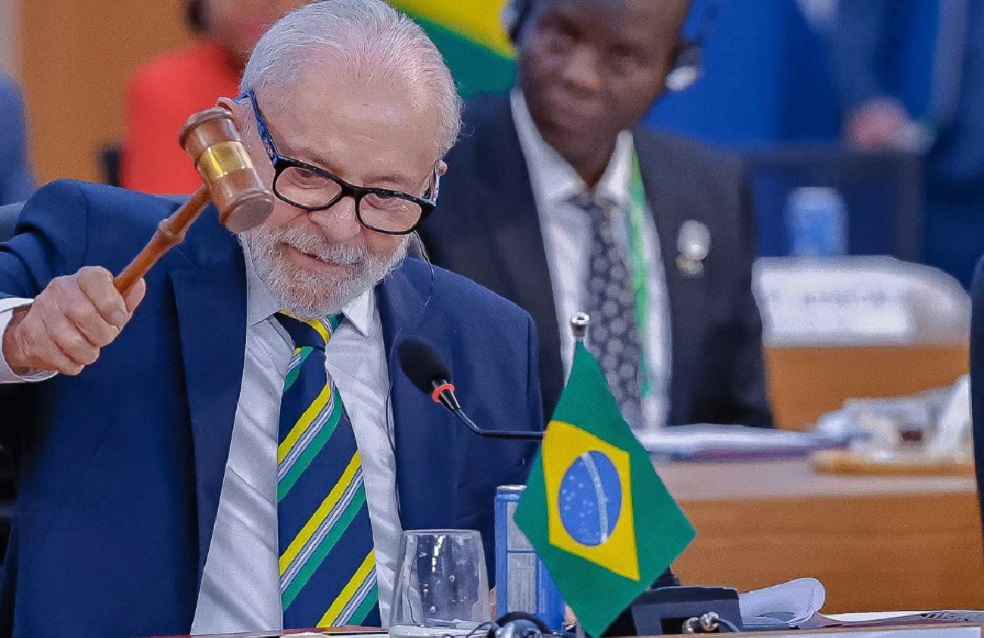
Brazilian President Luiz Inácio Lula da Silva on Wednesday stated that his government will enact reciprocal measures in response to U.S. President Donald Trump’s newly imposed tariff on Brazilian exports.
On Wednesday, President Trump declared that the United States will implement a 50% tariff on Brazilian imports beginning August 1. The decision, outlined in a formal letter to President Silva, stems partly from Brazil’s ongoing legal proceedings against former President Jair Bolsonaro.
Trump also cited what he described as a “very unfair trade relationship” between the two nations, noting that the new rate marks a sharp increase from the 10% tariff introduced in April.
In his response, Da Silva stated that any unilateral hike in tariffs would prompt Brazil to impose equivalent duties on American products.
Silva also referenced Brazil’s newly enacted Economic Reciprocity Law, a measure that authorizes the government to impose proportional trade retaliation in response to unilateral actions by foreign nations.

Early Thursday, President Silva assembled key Brazilian ministers to strategize a response to Trump’s proposed tariff hike. According to his chief of staff’s office, a task force will be assigned to evaluate potential countermeasures.
Trump asserted that Brazil’s trade policies have led to unsustainable deficits for the United States, posing risks to the economy and national security. However, U.S. government data shows the opposite: in 2024, the U.S. recorded a $7.4 billion goods trade surplus with Brazil. In his response, Da Silva challenged Trump’s claim, citing official figures to refute the deficit allegation. Trump also declared that the U.S. would initiate a formal investigation into Brazil’s trade practices, citing ongoing hostility toward the digital operations of U.S. companies as the basis for the probe.
The United States is Brazil’s second-largest trading partner after China; therefore the proposed tariff increase from 10% to 50% could deal a serious blow to Brazil’s economy. While Brazil is the 15th largest trading partner for the U.S., its key imports from America include mineral fuels, aircraft, and industrial machinery. In return, the U.S. relies on Brazil for gas and petroleum, iron, and coffee, among other goods.
POLICY & LAW | Kenya Mandates Certificate of Origin for all Imported Goods