


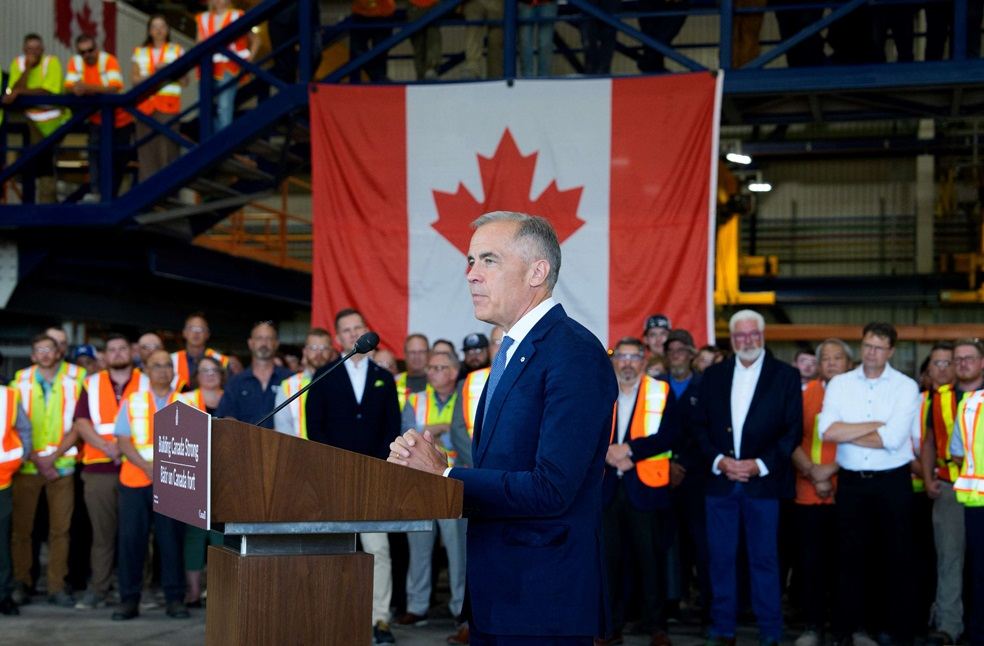
Prime Minister Mark Carney has set an ambitious target to double Canada’s non-U.S. exports within the next decade, warning that rising American tariffs are discouraging investment and undermining long-standing economic ties.
Speaking ahead of his government’s budget release on November 4, Carney said many of Canada’s former economic strengths, rooted in close relations with the United States, have now become liabilities.
“The jobs of workers in our industries, most affected by U.S. tariffs, autos, steel, and lumber, are under threat. Our businesses are holding back investments, restrained by the pall of uncertainty that is hanging over all of us,” he said.
Tensions between Ottawa and Washington have intensified under President Donald Trump, who has repeatedly raised tariffs on Canadian goods and controversially suggested that Canada could be “the 51st state.”

Carney told Canadians that the decades-long integration of the two economies had effectively reached its limit. “The U.S. has fundamentally changed its approach to trade, raising its tariffs to levels last seen during the Great Depression,” he said. “We have to take care of ourselves because we can’t rely on one foreign partner.”
While diplomatic efforts have eased tensions slightly as both governments explore a new trade deal, tariffs continue to weigh heavily on key Canadian sectors, including aluminum, steel, autos, and lumber. More than 75% of Canada’s exports currently go to the United States.
Carney said Canada is now working to deepen trade relationships with ‘global giants’ India and China to diversify its markets.

He also described Canada as an “energy superpower,” citing the nation’s vast natural resources, the world’s third-largest oil reserves, and fourth-largest natural-gas reserves.
Canada supplies about 60% of U.S. crude imports and 85% of its electricity imports, along with being the top foreign source of steel, aluminum, uranium, and several critical minerals vital to U.S. national security.
“I will always be straight about the challenges we have to face and the choices we must make,” Carney said. “To be clear, we won’t transform our economy easily or in a few months; it will take some sacrifices and some time.”
Canada’s free-trade agreement with the United States is due for review in 2026, a process likely to further test one of the world’s closest but most complex trade relationships.
BANKING & FINANCE | U.S. Exim Issues $2.2 B Funding for Aussie Minerals Projects